
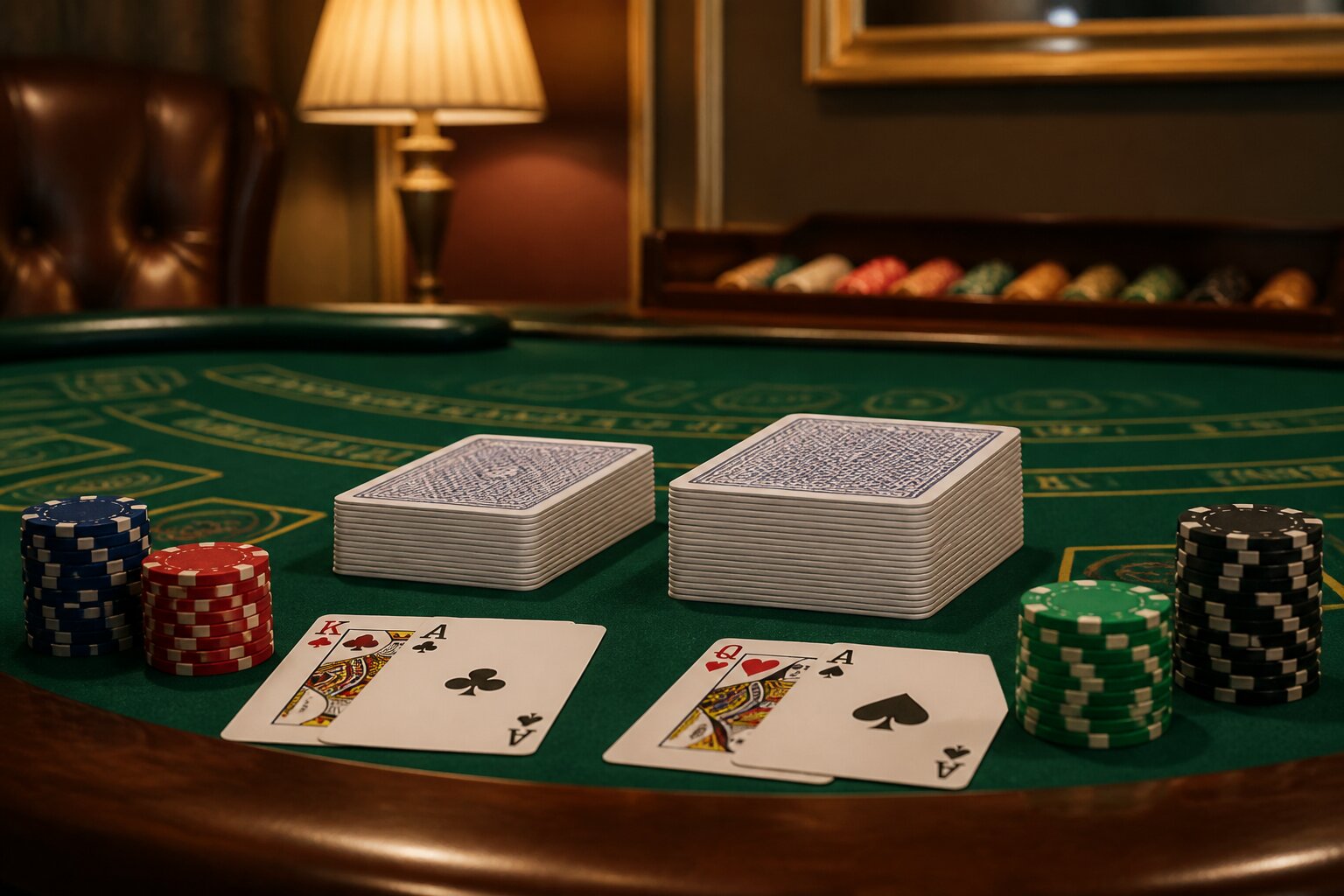
Are you curious how the number of decks in blackjack affects your chances and the way the game plays out? Many players assume deck count is a small detail, but it changes the flow, the odds and sometimes the rules you’ll encounter.
Before you sit at a table or open an online game, it helps to understand what those differences mean in practice so you can choose the version that suits you best.
Read on to see how deck size influences house edge, rule variations and payouts, and to learn simple ways to check what you’re playing.
What Is the Difference Between 2 Deck and 6 Deck Blackjack?
At its simplest, the difference is the number of 52-card decks used. Two-deck blackjack uses two decks shuffled together; six-deck blackjack uses six. That change affects how often particular cards appear, how long a shoe lasts before reshuffle, and how easy it is to track which cards have been played.
Fewer decks mean more frequent reshuffles and slightly more predictability in the short term — for example, certain hands such as natural blackjacks will occur at a modestly different rate than in a large shoe. With a six-deck shoe, games tend to run longer between shuffles, and card distributions feel smoother over a larger sample of hands.
Table rules often look similar across deck sizes, but there can be important variations at individual tables. Limits on splitting, whether doubling after a split is allowed, and dealer behaviour on a soft 17 are examples of rules that might differ. Because these specific rules can change the math more than deck count alone, take a moment to check them before you play.
If you’re new to these details, thinking of deck size as one part of a wider rules package helps — it’s the combination of deck count and table rules that shapes the experience.
How Does Deck Size Affect the House Edge?
Deck size has a real, if modest, effect on the house edge. All else being equal, fewer decks slightly reduce the casino’s advantage. For example, with standard rules and basic strategy, a two-deck game might show a house edge around 0.35%, while a six-deck game under similar rules could be closer to 0.50%. Those numbers shift when rules change.
Why does this happen? When there are fewer cards, the probability of receiving certain hands and the relative frequency of ten-value cards and aces change. That alters the balance between winning and losing hands in a way that slightly favours the player when decks are reduced. However, rule changes such as a 6:5 blackjack payout or the dealer hitting on soft 17 can offset or even reverse that benefit.
So, deck size matters, but it’s best viewed alongside the full set of table rules to understand the real impact on expected returns.
Rules Variations: What Changes With More Decks?
Casinos sometimes adjust rules to balance differences that arise from deck count. You may find limits on splitting or restrictions on doubling down at two-deck tables, while six-deck games can offer more or fewer options depending on the house’s approach. Dealer rules — whether the dealer hits or stands on a soft 17 — also vary and have a measurable effect on the house edge.
Payouts for a natural blackjack usually remain the standard 3:2 at many tables, but alternate payouts such as 6:5 do appear and significantly affect returns. These kinds of rule tweaks are why comparing tables by rules is more important than focusing on deck count alone.
A quick note before we move on: checking the table’s rules is a practical step that pays off. It tells you whether any apparent advantage from fewer decks is preserved or diminished by other terms.
Are Payouts Different in 2 Deck vs 6 Deck Blackjack?
Payouts are tied to the table rules rather than the number of decks, so both two-deck and six-deck tables can offer the common 3:2 payoff for a natural blackjack, or the less favourable 6:5 pay in some formats. That means you can find 3:2 on either deck size and 6:5 on either deck size, depending on the house rules.
Insurance payouts, when offered, typically pay 2:1. Whether insurance is available and the exact conditions for taking it depend on the specific table rules rather than the deck count. Other side rules, such as whether the dealer checks for blackjack or if late surrender is permitted, will likewise depend on the table setup.
A change from 3:2 to 6:5 has a much larger effect on long-term returns than the difference between two and six decks. Because of that, prioritise payout structure when choosing a table if your aim is to preserve expected value.
Other practical factors to consider include:
- game speed, which affects how many hands you play per hour;
- betting limits, which determine whether the table fits your bankroll;
- your comfort with the format, including how rules and dealer behaviour vary by casino.
Always check the rules posted at the table before you play, and gamble responsibly.
Why Do Casinos Use More Decks?
Casinos favour larger shoes for practical reasons. Six-deck shoes reduce the frequency of shuffles, keeping games moving and improving table throughput. A bigger shoe also makes card-tracking techniques less effective, which helps preserve the house edge.
From an operational perspective, longer shoes mean fewer interruptions and a steadier flow of play for dealers and players alike. The slight shift in odds that comes with extra decks is a secondary consideration to these practical benefits.
Common Myths About Deck Size in Blackjack
There are a few persistent myths worth correcting. One is the idea that deck size alone can guarantee better returns; while fewer decks tend to be more favourable, the difference is small and easily outweighed by other rules. Another is that single- or double-deck games always beat multi-deck games no matter what; in reality, payout ratios and splitting rules often matter more.
Finally, some people expect large jumps in odds when decks are added or removed. The actual changes in house edge are modest, so it’s the rule set as a whole that determines which table is preferable.
If you’re weighing options at a table, look for the full rule picture rather than relying on deck count as the deciding factor.
Which Version Offers Better Odds for Players?
When comparing like-for-like rules, two-deck blackjack usually gives players a slight statistical advantage over six-deck games. The difference is small, typically measured in fractions of a percent, so it rarely changes the overall experience for casual players. That advantage can be wiped out, however, by unfavourable payouts or restrictive rules on splitting and doubling at a low-deck table.
It is better not to assume that fewer decks are always superior. Instead, compare the full set of rules and conditions at each table. Key factors to check include:
- house edge and how it is reported
- payout structure, such as whether blackjack pays 3:2 or a less favourable ratio
- allowed plays, including rules on splitting, doubling down and surrender
- dealer behaviour, for example whether the dealer hits or stands on a soft 17
Considering these elements together will give you a much clearer sense of which game offers the better expected outcome for your style of play. Also bear in mind that short-term results are highly variable, and sensible bankroll management and responsible play remain important regardless of deck count.
How to Identify the Deck Size at a Casino Table
Knowing the deck size helps you understand the game you’re joining. In live venues, casinos commonly display deck count and key rules on a sign at the table alongside payout information. If the sign isn’t visible, asking the dealer or floor staff is a quick way to confirm the details.
Online, deck count and full game rules are usually shown on the game’s information screen or help menu. Look for an information icon or rules link to find the deck size, payout ratios and any special conditions before you begin.
A clear check of these details ensures you’re choosing a table whose rules align with your expectations. Set personal limits and stick to them as you play.
**The information provided in this blog is intended for educational purposes and should not be construed as betting advice or a guarantee of success. Always gamble responsibly.