
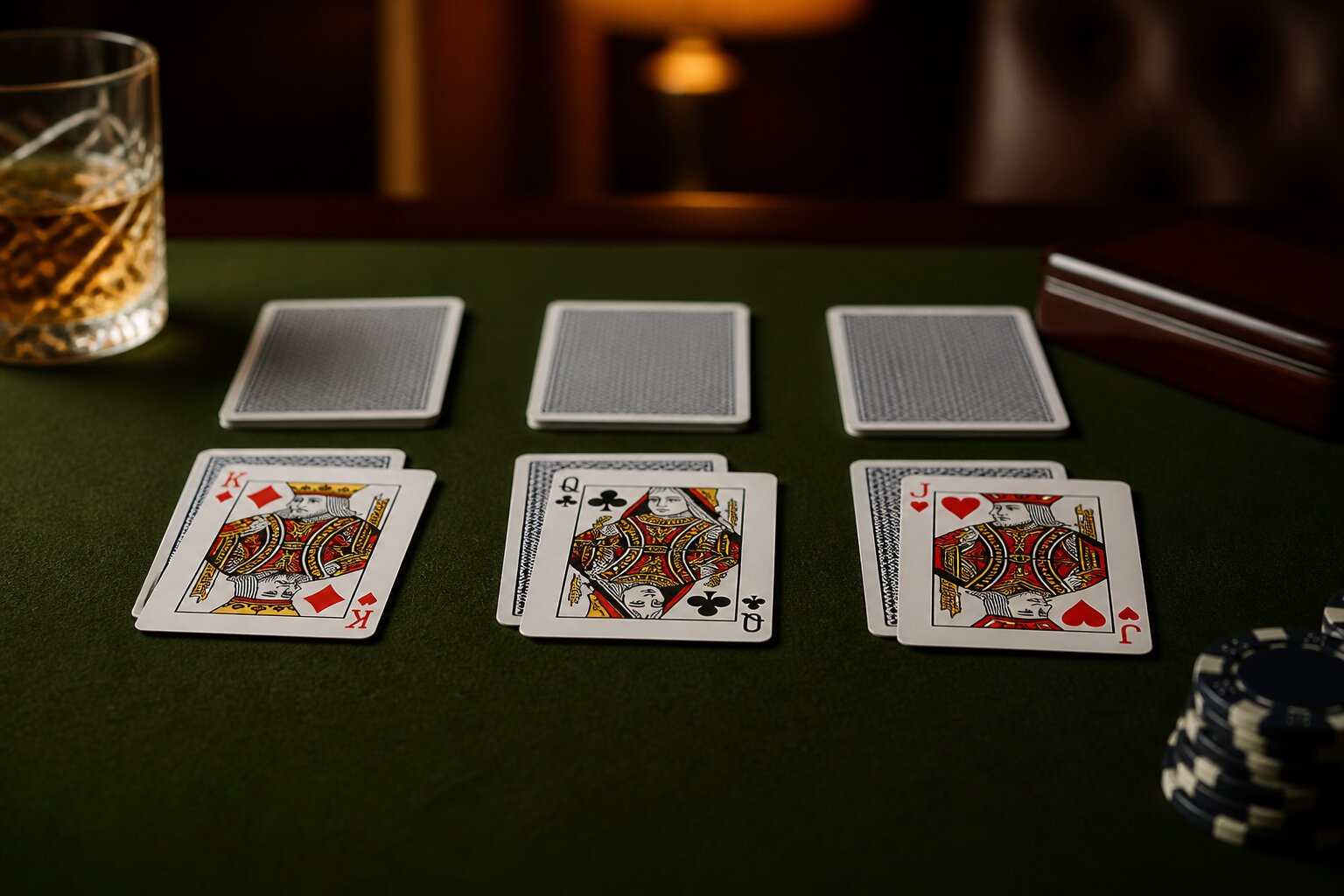
If you’ve ever sat down to play 3 Card Brag, you’ll know the central question is simple: who has the best hand? Understanding the order of hands makes it much easier to follow a round and to judge whether to stay in or fold.
This guide explains the ranking system used in 3 Card Brag and gives clear examples so each category is easy to spot at the table. Read on to learn how hands compare and what to watch for when cards are revealed.
What Is 3 Card Brag?
3 Card Brag is a traditional British card game played with three cards per player from a standard 52-card deck. Rounds are quick and the rules are straightforward, which is why the game is common at social gatherings and among friends.
Players form the best three-card combination they can and use betting rounds to contest the pot; the result depends on the cards dealt, not player guarantees. The game is for adults only — players in the UK must be 18 or over — and it should be treated as light entertainment with sensible limits on play.
Now that the basics are clear, let’s move on to exactly how hands are ranked.
How Are Hands Ranked in 3 Card Brag?
The aim is to hold the highest-ranking three-card hand when all cards are shown. 3 Card Brag uses its own order of hands, which differs from many poker variants; knowing the hierarchy is essential for comparing hands at showdown.
Hands fall into five principal categories, listed from strongest to weakest. Within a category, ties are broken by card values; suits are rarely used and only come into play in specific tie situations. House rules can vary slightly on tie-breaking, so it is sensible to be aware of any local or venue-specific variations before you play.
The next section examines each category in detail so you can recognise them at a glance.
Ranking Overview
The five main categories are, from top to bottom: prial, running flush, run, flush, pair, and high card. Each has a clear definition and examples that follow, making it straightforward to decide which hand wins when two players contest the pot.
Below you’ll find a full explanation of each category and representative hands to illustrate them.
Highest to Lowest Hands Explained
Prial
A prial (short for “pair royal”) is three cards of the same rank and is the strongest hand in 3 Card Brag. Unusually, three 3s are treated as the absolute top prial in many traditional rules, outranking three aces. For example: 3♠ 3♦ 3♣ is the best possible hand under those classic rankings.
Other prials such as A♥ A♦ A♣ remain extremely strong but sit below the prial of threes under traditional ordering. Prials are rare and are generally unbeatable except by a higher prial, so they carry a great deal of value in play.
Running Flush
A running flush is three consecutive cards all of the same suit. The highest running flush is A K Q of a suit — for example, A♥ K♥ Q♥. Because this hand combines both sequence and suit, it is very powerful, but it still ranks below any prial.
Running flushes can be visually striking and are often easy to spot at a glance. When comparing two running flushes, the one with the higher sequence wins.
Run
A run is three consecutive cards of mixed suits. The highest run is A K Q, and an example would be 9♣ 10♦ J♠. Runs beat flushes and pairs but are weaker than running flushes and prials.
Runs are more common than running flushes but less common than pairs. When two runs are compared, the sequence values decide the winner, with the higher top card prevailing.
Flush
A flush is three cards of the same suit that are not in sequence. An example is 2♥ 7♥ 10♥. Flushes outrank pairs and high-card hands but sit below runs, running flushes and prials.
When two players both hold flushes, the ranks of the cards are compared in descending order to settle the tie, since suits usually do not affect the outcome.
Pair
A pair consists of two cards of the same rank plus a third card of a different rank, such as Q♣ Q♦ 4♠. Pairs are common and are decided by the rank of the pair first, then by the value of the single card as a kicker when two players hold the same pair.
Because pairs occur frequently, the kicker is often decisive in determining the winner between equal pairs. Knowing the relative values of the single cards is therefore useful in tight contests.
High Card
When no other combination is present, the highest single card decides the hand. For example A♠ 7♦ 2♣ is an ace-high hand. If two players share the same highest card, the next highest card is compared, and so on.
High-card hands appear most often and require careful tie-breaking by comparing cards in descending order until a difference is found.
With that structure in mind, the following section gives concrete examples of premium and everyday hands you might see.
What Are Some Example 3 Card Brag Hands?
Seeing examples helps the categories click. The hands below show the kind of combinations players commonly hold, from the rarest to the most frequent. They give a practical sense of relative strength so you can judge how aggressive or cautious to be in a hand.
Examples of Premium Hands
Premium hands often decide the largest pots because they are rare and strong. These are the combinations you will usually want to play aggressively when you are certain you hold them.
Prial of Threes: 3♣ 3♦ 3♥ (the strongest hand under classic rules)
Prial of Aces: A♠ A♥ A♦
Running Flush: 4♠ 5♠ 6♠
Ace-High Running Flush: A♦ K♦ Q♦
Top Run: A♣ K♠ Q♥ (highest non-suited sequence)
When two players both have a prial, the higher rank wins, and suits do not affect the ranking. Similarly, among runs and flushes, the highest cards determine the winner, so knowing the order of ranks is important at showdown.
Common Hand Examples
Everyday hands make up most rounds and are what you’ll compare most often. These examples show the kinds of middling and low-value holdings that appear regularly and how they fit into the overall ranking system.
Flush: 7♠ 9♠ Q♠ (same suit, not sequential)
Pair of Queens: Q♦ Q♣ 6♥
Pair of Nines: 9♠ 9♥ 2♦
High Card: A♠ 8♣ 5♦ (ace is the highest card)
High Card: K♥ 7♦ 3♣ (king-high with no other combination)
Recognising these common hands quickly helps with decisions during betting and at showdown, since most hands you see will be in these categories rather than the premium ones. Next, we’ll look at what sets 3 Card Brag apart from other familiar card games.
How Does 3 Card Brag Differ From Other Card Games?
3 Card Brag’s differences come down to hand order, card count and pace. Unlike many poker variants where three of a kind usually ranks below a straight flush, in traditional Brag a prial sits at the very top. That means three matching cards can beat a suited sequence such as A K Q.
Using only three cards per player shortens each round and reduces the number of possible combinations compared with five-card games. That tighter set of outcomes makes hand values more immediately interpretable, with fewer steps needed to judge strength.
Because rounds are faster and comparisons simpler, play tends to be brisk and conversational rather than drawn out. With the ranking system and examples now clear, you should be able to follow a game confidently and recognise which hands are most likely to win.
Explore Casino Table Games at Dove Casino
Fancy seeing what our casino has to offer? We welcome you to take a look around and enjoy the atmosphere at your own pace.
Getting started couldn’t be simpler – just create an account, make a deposit, and you’re all set to play. We’re here whenever you feel like having a go.
**The information provided in this blog is intended for educational purposes and should not be construed as betting advice or a guarantee of success. Always gamble responsibly.