
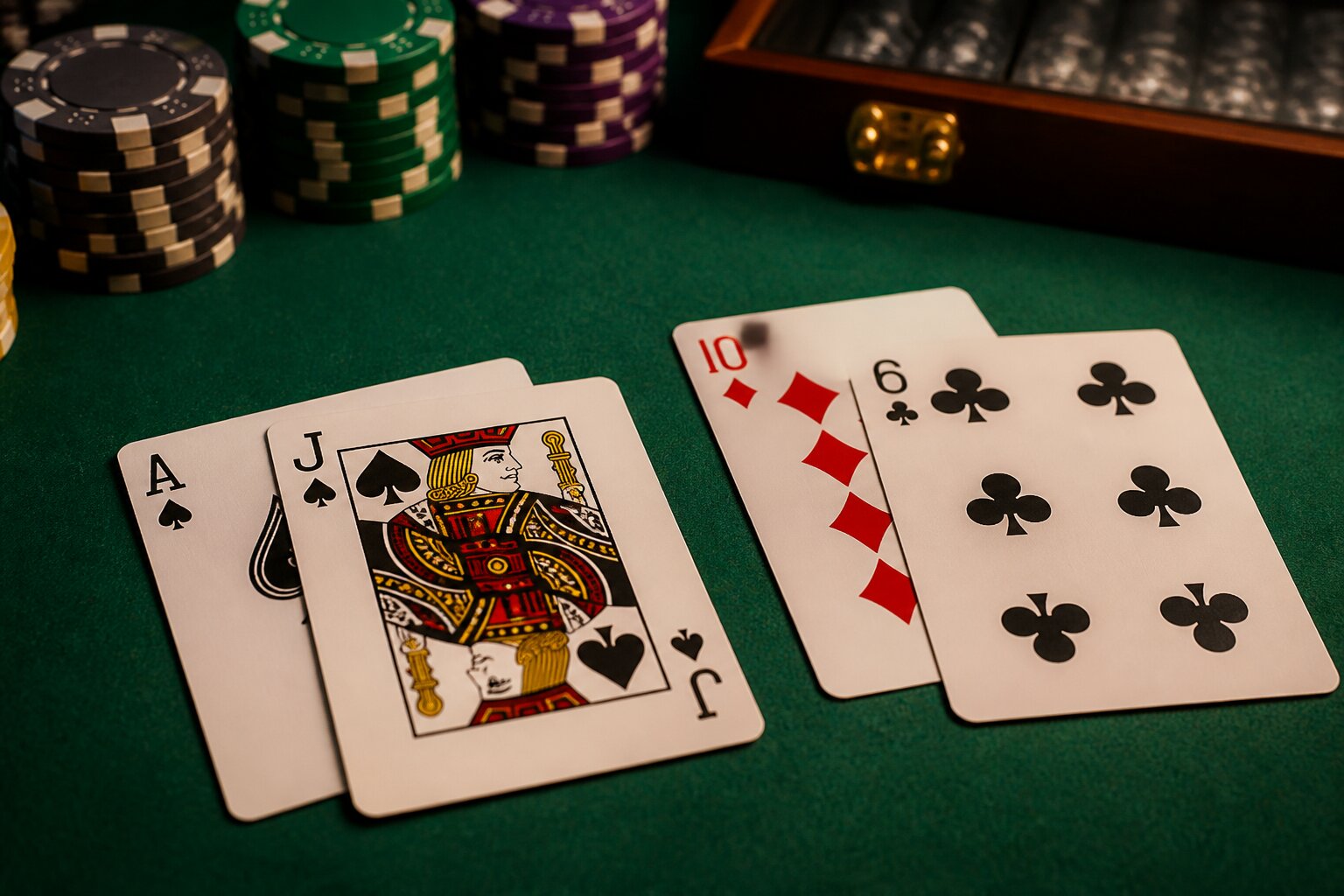
If you’ve ever sat down at a blackjack table, you’ll know the moment when the first two cards arrive can change everything. Knowing which hands are strong, which are risky and why they matter helps you make better choices at the table.
This guide explains the hand rankings, illustrates the best and worst starting combinations, and describes how dealer rules alter outcomes. Read on to see clear examples and practical context that make each ranking easy to recognise.
What Are Blackjack Hand Rankings?
Blackjack hand rankings describe how close a combination of cards comes to the target total of 21 without exceeding it. Cards 2–10 score their face value; Jacks, Queens and Kings are worth 10; and Aces can count as 1 or 11 depending on what benefits the hand. The higher the total up to 21, the stronger the hand, but the way that total is composed — whether it’s “soft” or “hard” — also changes how safe it is to draw extra cards.
The highest-ranking result is a natural blackjack: an Ace plus any 10-value card dealt as the first two cards. This outcome is treated separately because it immediately reaches 21 and typically has a better payout than other winning hands.
Knowing how values and hand types work sets you up to weigh the strengths of specific hands, which is what we’ll examine next.
Understanding the Best Blackjack Hands
The top hands are those that reach 21 or come very close with little room for the dealer to beat them. A natural blackjack remains the peak because it is an immediate 21 from two cards and usually receives a premium payout. In single-deck play, a natural appears roughly once every 20 hands, so while it is the most favourable result, it is still relatively uncommon.
Hands totalling 20 or 19 are the next-best starting positions. A 20 (for example, King + Queen) leaves the dealer with a narrow path to improvement, and many decisions can safely end with standing. A soft 19 (Ace + 8) keeps flexibility: the Ace can shift value if another card is taken, which lessens the risk of busting. These hands don’t guarantee a win, but they reduce the number of difficult choices a player faces.
Next we will look at the weaker hands that create the trickiest decisions and why they often force a player into uncomfortable calls.
Identifying the Worst Blackjack Hands
Some two-card combinations place a player in a particularly awkward position because they are hard to improve and easy to lose with. A hard 16—say 10 + 6—is widely regarded as one of the most difficult hands. It is too high to hit comfortably (many draws will bust) and too low to stand confidently against higher dealer totals. A hard 15 carries similar problems.
Hard totals of 12 to 13 also bring frequent dilemmas. These hands can survive a small draw but risk a bust with many common cards. When these totals meet a strong dealer upcard, the pressure to act increases and the margin for error becomes thin.
Knowing which hands are prone to busting helps explain how risk changes with each hit, which we’ll clarify next by outlining how hands are valued and how that affects decisions at the table.
How Are Blackjack Hands Valued?
Values are calculated by summing card points with Aces adjustable as 1 or 11 to the player’s advantage. A hand containing an Ace that can be counted as 11 without exceeding 21 is called soft; if the Ace must be 1 to avoid busting, the hand is hard. For example, Ace + 6 can be 7 or 17 (soft 17), while 10 + 7 is a hard 17.
This flexibility matters because soft hands allow more freedom to draw without the same risk of busting that hard hands carry. A soft 17 can absorb a high card by converting the Ace from 11 to 1, whereas a hard 17 has no such safety net.
Understanding soft versus hard totals clarifies why identical numeric totals can demand entirely different choices, and this distinction becomes clearer when we look at common player hands and the situations they create.
Examples of Common Player Hands
Below are typical hands you’ll see often, with what each total means in practice and why it tends to be comfortable or awkward to play.
- Ace + 9: Total 20. A robust hand with little need to act further; it is second only to a natural blackjack.
- 10 + 6: Total 16. A difficult position because many draws will bust, and standing leaves a narrow margin.
- Ace + 8: Total 19 (soft). Flexible and relatively safe; still vulnerable to a dealer 20 or natural 21.
- 7 + 7: Total 14. Too low to stand confidently but not so low that hitting is risk-free; splitting is sometimes considered when rules allow.
- 9 + 7: Total 16. Another classic dilemma similar to 10 + 6, often forcing a tense choice.
- 5 + 4: Total 9. A favourable spot for taking another card, since the risk of busting is low and improvement is likely.
- King + 5: Total 15. A weak starting hand against strong dealer upcards, leaving little comfortable play.
These examples show how the same numerical totals can differ in playability depending on softness, composition and dealer exposure. With that in mind, we’ll next compare how dealer rules influence these outcomes.
How Dealer Hands Compare to Player Hands
Dealer rules fix how the house plays, which in turn affects the relative strength of player hands. The dealer reveals one upcard that gives players a hint about the likely outcome. A strong dealer upcard, like a 10-value or an Ace, tends to narrow the safe options for players holding middling totals, while a weak upcard (such as 4, 5 or 6) increases the chances the dealer will bust when forced to draw.
Dealers must follow a strict protocol: they draw on totals of 16 or less and stand on 17 or more, though some games require the dealer to hit soft 17. This mechanical approach removes judgment and creates patterns players can anticipate. For example, a player with soft 18 against a dealer 6 will usually be in favourable position because the dealer is likely to draw into a weak final total.
Because the dealer’s actions are set, players must weigh their own starting hands and the visible dealer card together to judge whether to stand or risk drawing. That comparison is the key to understanding how starting hands perform over many rounds.
Final statement: recognising how hand composition, soft versus hard totals and fixed dealer rules interact gives a clear framework for evaluating any blackjack starting hand and making informed choices at the table.
Explore Casino Games at Dove Casino
We welcome you to be part of our Dove Casino community, where players come together to enjoy a relaxed and friendly atmosphere. Discover the fun of exploring casino games alongside others who share your interest.
**The information provided in this blog is intended for educational purposes and should not be construed as betting advice or a guarantee of success. Always gamble responsibly.