
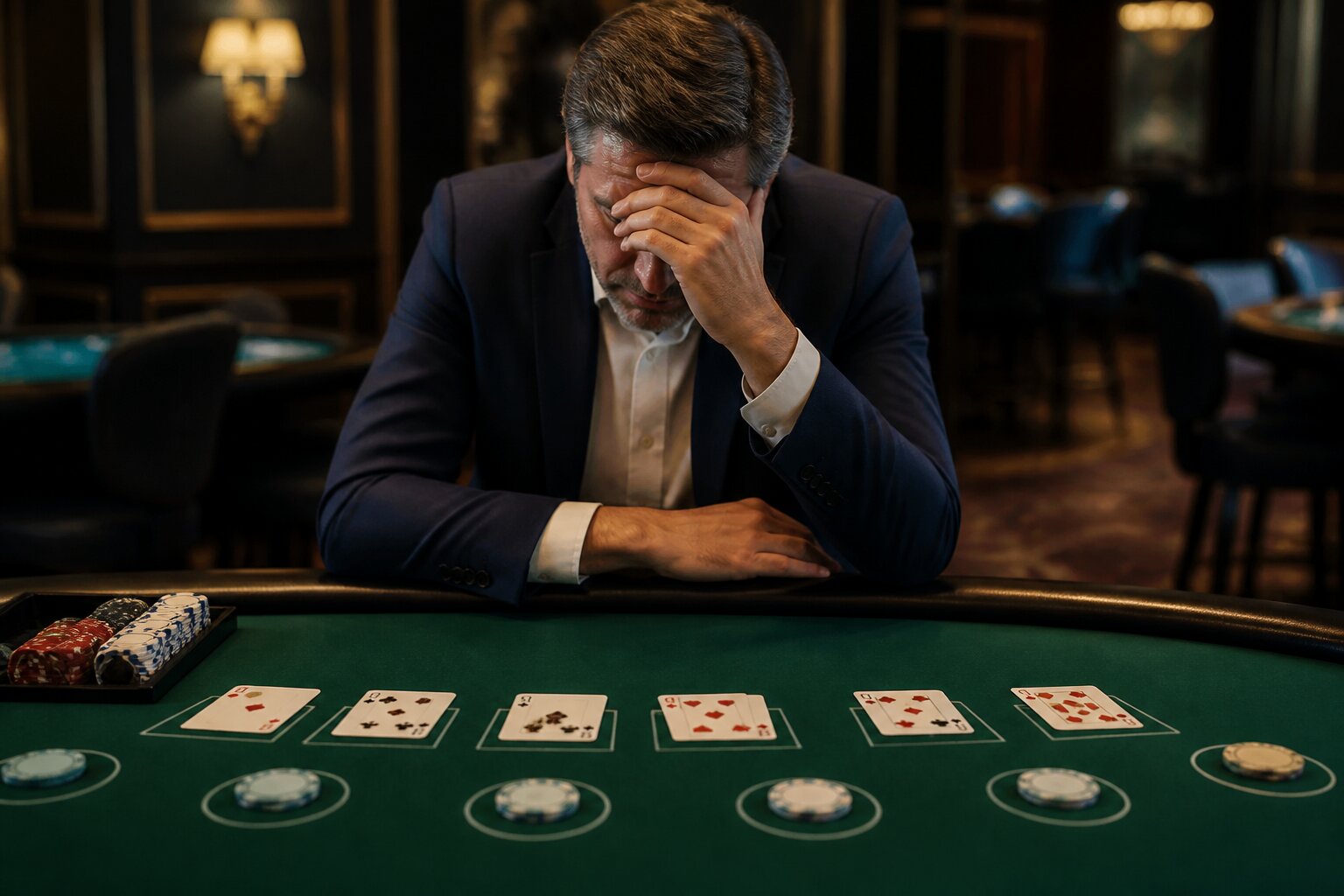
Ever wondered why results sometimes go against you at the blackjack table—even when you’re following the right strategy? You’re not alone: streaks of losses happen to players at all levels.
Understanding the probability behind consecutive losses can change how you approach the game, help you set realistic expectations, and support safer play.
Keep reading to see what the maths says about losing streaks and how that can inform better decisions at the table.
How Does Probability Work in Blackjack?
Probability in blackjack describes how likely particular cards or outcomes are during a hand. Each hand starts from a shuffled deck, so the precise cards dealt are uncertain. For example, the chance of receiving a natural blackjack on your initial two cards is just under five per cent.
Decisions such as hitting, standing, splitting or doubling down alter the immediate odds for that hand, but they do not change the fact that each hand’s outcome is determined by the cards. The rules of blackjack give the house a small built-in advantage; basic strategy minimises that edge but cannot remove it entirely.
When considering losing streaks, the key point is that hands are effectively independent when decks are shuffled regularly. If you know the approximate chance of losing one hand, you can calculate the chance of losing several in a row by multiplying that single-hand probability for each hand in the sequence. This arithmetic shows why even well-played sessions can include runs of losses and why expectations should be based on probability rather than assumptions about patterns. The next section takes those single-hand odds and applies them to multi-hand streaks.
What Are the Chances of Losing Several Hands in a Row?
The likelihood of losing multiple hands in succession follows directly from the probability of losing a single hand. Under standard rules and when using basic strategy, a player typically loses roughly 48% of hands; the rest are wins or pushes. Using that as a baseline, consecutive-loss probabilities fall rapidly as the streak lengthens.
To illustrate: the chance of losing four hands in a row is about 5% (0.48^4 ≈ 0.053), meaning such a streak will occur roughly once every twenty attempts. A six-hand losing streak is far less common—around 1.2–1.5% (0.48^6 ≈ 0.012)—so it appears roughly once in eighty streaks. These figures come from multiplying the single-hand loss probability by itself for each hand in the sequence.
Because each hand is independent under normal shuffling, a previous loss does not change the next hand’s chances. Recognising this helps avoid reactionary decisions born of frustration. With that in mind, it’s useful to consider which game factors can make streaks more or less likely in practice.
Factors That Influence Losing Streaks in Blackjack
A few elements affect how often and how long losing streaks appear. Some relate to the game’s structure, while others depend on player choices. None eliminate the possibility of a streak, but they influence the statistical landscape over many hands.
Deck size and shuffling practices change the distribution of cards and hence the house edge. So do rule variations such as dealer standing on soft 17, the number of splits allowed, or whether surrender is offered. Player decisions also matter: consistently applying basic strategy keeps the house edge low, while deviating from it increases the chance of extended losses over time.
Finally, emotional and behavioural factors—like chasing losses or varying bet sizes impulsively—can magnify the financial effect of streaks. Awareness of these influences helps keep expectations realistic and play sustainable. The following two subsections look more closely at deck and shuffle differences, then at player choices.
Deck Size and Shuffle Method
The number of decks in use alters the house edge and the frequency of certain card combinations. Single-deck tables typically offer the best odds for the player when paired with correct strategy, while games using multiple decks present a slightly larger house edge. Over many hands, even small differences in edge can change how often losing sequences appear.
Shuffle method matters too. Frequent shuffling or continuous shufflers make each hand effectively independent by preventing card tracking. Less frequent shuffling can create short-term sequences where card distributions deviate from the average, but these are still part of normal variance and not a reliable basis for predicting future outcomes. Understanding these technical differences helps explain why streaks occur without implying any deeper pattern.
Player Decisions vs. House Edge
Basic strategy reduces the house edge by guiding the statistically best play for most situations, but mistakes or systematic deviations increase the edge. Actions such as taking insurance frequently, making ill-advised splits, or hitting when basic strategy recommends standing will raise the chance of losing hands over time.
No strategy eliminates the house advantage, and so even optimal play cannot prevent losing streaks. Managing decisions with awareness of their statistical impact keeps sessions within reasonable limits and reduces the longer-term likelihood of deep financial loss. With that practical context covered, the next section considers how often long losing runs actually appear in normal play.
Are Longer Losing Streaks Common in Blackjack?
Longer streaks are more likely to appear the more hands you play. In a sample of 100 hands, statistical models show a significant chance of encountering a run of six or seven consecutive losses, even for players following basic strategy. For instance, losing seven hands in a row with a 48% single-hand loss rate has a probability of about 0.7% for any given seven-hand block; examined across many overlapping blocks in a 100-hand session, the chance of seeing at least one such streak becomes appreciable.
These extended runs are a manifestation of variance: sequences will include both favourable and unfavourable runs over time. That means experiencing a long losing streak does not signal a change in the underlying odds. Knowing this can reduce the urge to adjust bet sizes dramatically in response to a streak and supports steadier, more considered play. Next, we’ll compare how losing streak patterns in blackjack stack up against other common casino games.
Comparing Blackjack Losing Streaks to Other Casino Games
Different casino games have different win frequencies and house edges, so streak patterns vary between them. Blackjack, when played with correct strategy, tends to have a relatively high frequency of non-loss outcomes compared with many slots, but similar streak chances to other near-even bets.
For example, European roulette’s red/black bets win about 48.6% of the time; short losing streaks therefore occur at rates comparable to blackjack. Baccarat’s banker and player bets also produce similar streak patterns because their win probabilities are close to even after accounting for the house commission on banker bets. By contrast, many slot games have a lower “hit rate” — perhaps around 30% — meaning long no-win sequences are more likely within a given number of spins.
Understanding these differences helps set expectations when switching between games: some formats produce longer dry spells simply because fewer winning events occur per play. Having placed this comparison in context, the final section outlines practical measures to keep play controlled during streaks.
Practical Ways to Manage Losing Streaks
Managing losing streaks is fundamentally about control: of your budget, your time, and your reactions. Establishing a firm bankroll limit before a session and sticking to it prevents losses from becoming serious. Similarly, setting session lengths or taking regular breaks reduces the risk of decisions made in the heat of the moment.
Emotional awareness is key. If frustration mounts during a sequence of losses, stepping away from the table allows perspective to return and avoids impulsive bets intended to recoup losses. No betting system will erase the inherent risk of streaks, so measures that protect finances and wellbeing are the most effective response.
For impartial advice and support if gambling becomes a concern, free confidential resources are available via BeGambleAware.org. Keep play affordable and deliberate, and accept that streaks are part of the game’s statistical nature.
This wraps up the practical and statistical perspective on losing streaks in blackjack: knowing the odds helps you plan and stay in control, so sessions remain a manageable form of entertainment rather than a source of stress.
Play Casino Games Online at Dove Casino
We welcome you to play casino games on our site at a pace that suits you. Take your time and enjoy the experience in a relaxed setting with us.
**The information provided in this blog is intended for educational purposes and should not be construed as betting advice or a guarantee of success. Always gamble responsibly.