
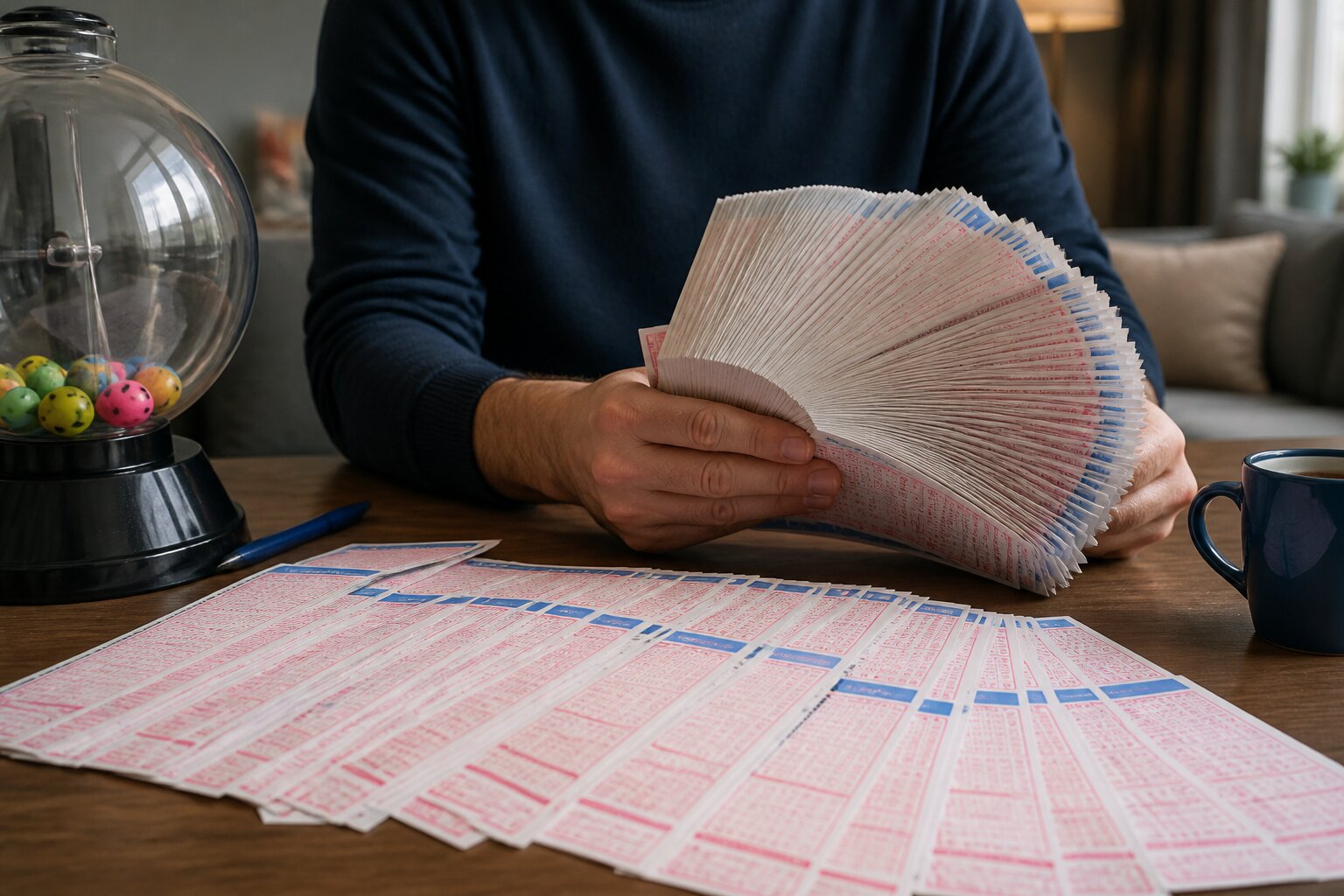
Have you ever wondered what would happen if you bought every possible lottery ticket? It’s an alluring idea—the certainty of a jackpot simply by covering all combinations.
Before you start picturing the payout, it helps to understand the maths, the practical barriers and the real financial exposure involved. This article breaks those elements down so you can see why the fantasy differs from reality.
If you want the full picture on costs, odds and whether this strategy could ever make sense, read on.
How Many Lottery Combinations Are There?
The total number of possible combinations depends on a game’s format. For the UK Lotto you pick six numbers from 59. Combinatorics tells us how many unique lines that produces, using the formula for combinations: n! / [r!(n – r)!], where n is the pool size and r is how many are chosen.
Applying that to 59 choose 6 gives 45,057,474 possible combinations. To give context, smaller or differently structured draws such as Thunderball or EuroMillions use different pools and therefore have different totals, but they still produce millions or hundreds of millions of distinct lines in most cases.
Understanding the scale of those figures makes it clear why buying every combination is a vast undertaking; it’s the reason costs and logistics quickly become the primary obstacles.
What Would It Cost to Buy Every Combination?
At a basic level, cost is the ticket price multiplied by the number of combinations. With a £2 ticket and 45,057,474 combinations, covering every UK Lotto line would cost £90,114,948 for a single draw.
Bigger draws with larger pools multiply that cost dramatically. EuroMillions combinations, for example, are far larger because of the extra numbers involved, pushing the total bill well into the hundreds of millions if someone attempted the same approach.
A further point to consider is additional outlays that don’t show up in the simple multiplication: transaction fees, staffing for purchase and handling, and secure storage for millions of tickets. These operational expenses can add materially to the base cost, and they become a significant part of the overall calculation.
Odds of Winning: What Does Buying Every Ticket Guarantee?
Holding every possible combination for a single draw means one of your tickets will match the drawn numbers, so a top-tier prize will be among your holdings. But whether that results in a profitable outcome depends on several other factors.
If any other ticket sold by the public matches the same numbers, the top prize is shared equally among winners, reducing the amount you ultimately receive. Prize pools are divided by the number of winners, so the nominal jackpot does not translate automatically into a sole payout.
In addition to the jackpot, owning every line means you will hold every possible lower-tier winning pattern for that draw. Those tiered prizes also face possible division if other players win at the same level. Altogether, the final cash return is the sum of all prize payments you receive, minus the full purchase cost and any extra handling expenses — and that net figure can be lower than the money spent.
Practical Challenges in Purchasing All Combinations
Even with sufficient capital, large-scale purchasing runs into many non-financial obstacles. Retail and online systems are not set up to process millions of lines in a single sweep.
Retailers commonly limit the number of tickets sold per transaction. Repeated bulk purchases are likely to attract attention and can be refused. Online platforms likewise enforce purchase limits and anti-fraud checks that make automated mass buying difficult.
Beyond sales controls, the physical logistics are formidable. Printing millions of tickets requires coordination with printing services and strict timeframes to ensure all lines are issued before a draw. Once printed, tickets must be tracked and stored securely to prevent loss, damage or misplacement. Any missing ticket risks voiding the intent to cover all combinations and could undermine the whole venture.
These practical barriers mean that, even if the money were available, executing the purchase reliably is far from straightforward. The operational complexity alone is often enough to make the idea unworkable.
Tax and Legal Considerations in the UK
In the UK there is no tax on lottery prize money itself, so winners receive their prize amounts without automatic income tax or capital gains tax applied at source. That said, tax considerations can arise later: interest earned on banked winnings will be taxable, and substantial gifts or transfers could have inheritance tax implications in some circumstances.
Legal rules also set who may participate: only adults of legal age can purchase tickets and claim prizes. Licensed outlets and online services are required to follow regulations designed to protect consumers and prevent illicit activity. Repeated attempts to purchase excessive volumes of tickets may attract scrutiny or intervention from providers enforcing these safeguards.
These legal and fiscal frameworks shape what is practically possible and add another layer of constraint to any attempt at covering every combination.
Does Anyone Ever Try to Buy Every Lottery Combination?
Attempts to cover all combinations have been tried, but only rarely and typically in much smaller games where the total number of combinations was manageable. In such cases groups pooled resources and handled the operational workload together.
In modern national lotteries, high combination counts, regulatory limits and operational hurdles make large-scale coverage impractical for most groups. Even where the cost might be within reach for a syndicate, the chance of sharing prizes with other winners and the logistical burden often outweigh any prospective benefit.
These historical examples serve to illustrate the point: covering every line is sometimes technically possible for very small draws, but for mainstream national games it is effectively out of reach for all practical purposes.
Debunking Common Myths and Misconceptions
One persistent myth is that buying more tickets necessarily improves the likelihood of ending up ahead. While more tickets do increase the proportion of combinations you hold, they do not alter how prizes are divided among winners or change the structure of the prize pool. Large purchases can still leave you sharing prizes or receiving less than the total cost once expenses are counted.
Another misconception is that systems can be outmanoeuvred to guarantee profit. Modern draws use audited procedures and strict controls to ensure outcomes and prize distributions are handled transparently; there are no reliable shortcuts that convert bulk purchasing into a dependable financial strategy.
Understanding these realities helps spot overstated claims and clarifies why mass buying remains a high-risk, low-reward proposition in most practical settings. The next section pulls these strands together to answer the central question: is it worth trying?
Conclusion: Is Buying Every Ticket Worth It?
In theory buying every lottery ticket for a draw would secure a winning line, but in practice the idea breaks down under financial, operational and regulatory pressures. Costs for major draws run into tens or hundreds of millions, logistics complicate execution, and prize-sharing can erode any hoped-for gains.
Lotteries are structured so that even large-scale purchasing carries substantial risk of loss once expenses and divided payouts are taken into account. For most people, the practical and legal barriers combined with the uncertain net return make this strategy neither feasible nor sensible.
If you choose to play, it is sensible to treat the activity as entertainment and to keep spending within personal limits. That way the experience remains controlled and any costs are ones you are prepared to bear.
**The information provided in this blog is intended for educational purposes and should not be construed as betting advice or a guarantee of success. Always gamble responsibly.