
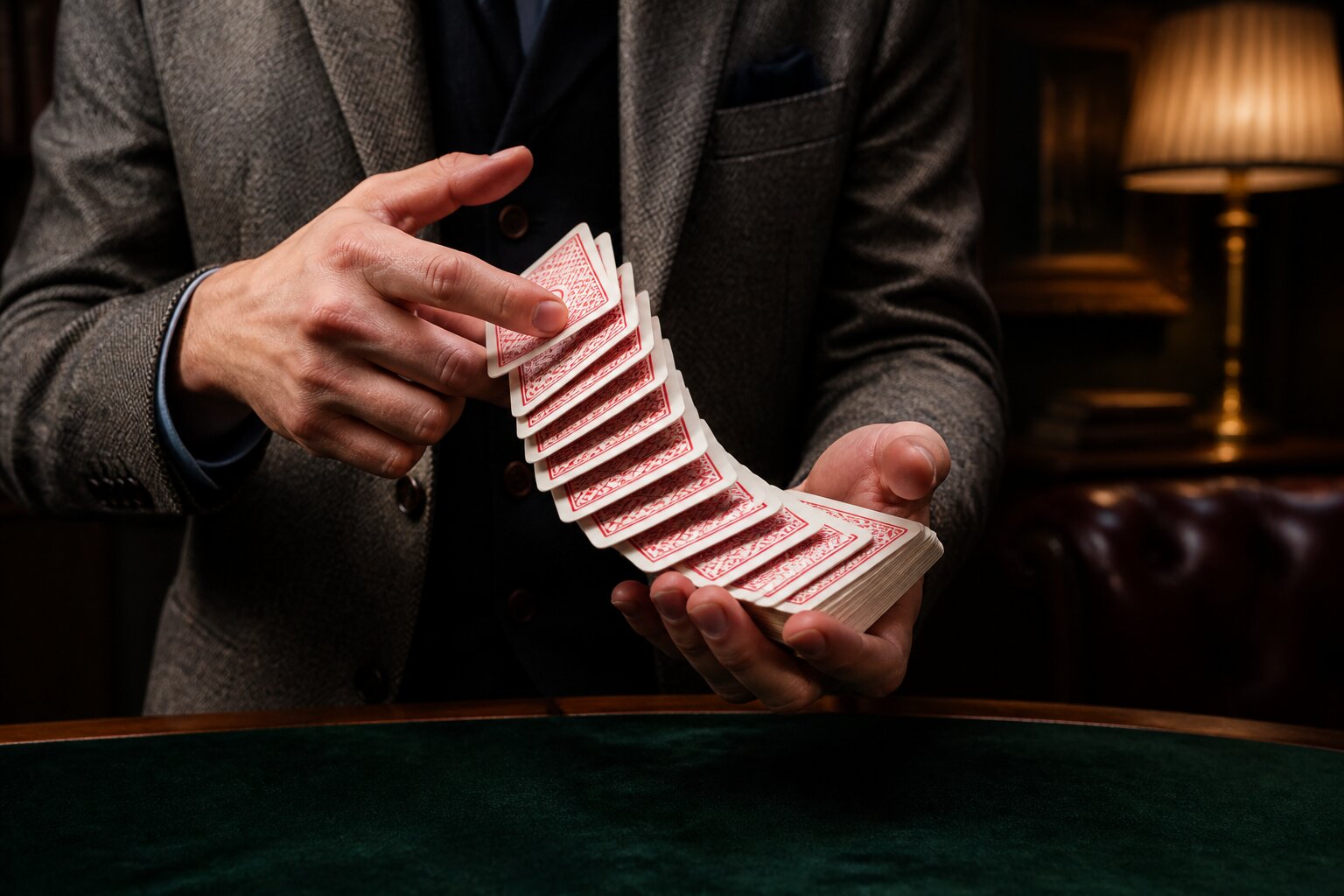
Ever wondered how magicians shuffle a deck and still control where the cards go? Or how skilled card players make shuffling look like a performance in itself?
Card sleight and shuffle tricks are the backbone of card magic and close-up performance. Whether you want to entertain friends, add flair to a social gathering, or begin exploring magic more seriously, this guide walks you through techniques, explanations and practical context to build real skill.
Read on for clear, usable descriptions of classic moves, common pitfalls to avoid and reliable resources to develop your practice.
What Are The Most Impressive Card Shuffle Tricks?
Learning eye-catching shuffles is as much about presentation as it is about dexterity. The shuffles below are well known because they combine visual appeal with practical control, and each one suits different styles of routine and performance. Practising them also builds timing, rhythm and confidence when performing.
The Riffle Shuffle
The riffle shuffle splits the deck and lets the cards interlace while producing a neat, rhythmic sound. It is often used as a standard shuffle in both close-up and stage work because it looks natural and authoritative.
When finished with a bridge flourish, the riffle shuffle looks polished and signals mastery of timing and pressure. The bridge adds a pleasing visual arc that helps to sell the idea the deck has been thoroughly mixed.
The Hindu Shuffle
This movement passes small packets of cards from one hand to the other in a controlled cascade. It is quick to perform and is commonly used in routines that need a casual, conversational feel.
The Hindu shuffle is useful when you want to keep particular cards undisturbed while giving the impression of mixing the deck. It is also a good choice for easing into more deceptive moves or false shuffles.
The Overhand Shuffle
A compact, flexible technique that supports a range of subtleties. With a loose grip and fluid fingers, the overhand shuffle becomes a tool for concealing or preserving card positions without drawing attention.
Experienced performers can vary speed, packet size and grip to make the overhand shuffle look ordinary while secretly controlling cards. It is an excellent everyday shuffle to have ready for both walking routines and table work.
The Table Faro Shuffle
Working the cards across a surface, the table faro interweaves two halves with precision. Its visual neatness makes it especially satisfying in close-up shows where careful alignment is visible to the audience.
The table faro requires careful alignment and control, so it stands out during performances where viewers can inspect the deck afterwards. It rewards patience in practice because a clean faro is a strong demonstration of technical skill.
The One-Handed Shuffle
This showcases dexterity: the whole deck is manipulated by a single hand in a confident, expressive way. It looks impressive and can serve as a highlight or surprise in a routine.
It takes time to develop but makes a striking impression when included in a performance. Beyond pure showmanship, the one-handed shuffle also helps build overall hand strength and coordination.
Essential Card Sleight Techniques Explained
Those striking shuffles are supported by core sleight techniques that magicians use to control and present cards. Each technique has practical uses in routines, and learning them builds the foundation for more complex sequences. Working on these basics will also improve your timing, misdirection and overall table presence.
The Double Lift
The double lift involves turning two cards as one so the performer can display a face while keeping another card hidden. It is fundamental for many reveals and for managing audience perception of which card is being shown.
Practise getting a clean grip and a smooth turnover so the cards look and feel like a single card. Start slowly, then speed up while keeping the motion natural. Work on the cover and patter that distract attention from the exact moment of the turnover.
The Palming Technique
Palming hides a card in the hand while keeping the fingers and wrist looking relaxed and natural. Well executed palming lets a card appear to vanish or reappear in a way that feels seamless to spectators.
Focus on hand angles and hand shape so the palm reads as empty from common viewing positions. Build endurance by holding a palm while speaking or performing other small actions, and practise producing the card cleanly when needed.
The False Cut
A false cut creates the impression of thorough mixing while retaining the deck order. Various forms exist, some quick and subtle, others elaborate and theatrical, depending on whether the goal is deception or spectacle.
Choose a false cut that suits your style and the routine. Simpler cuts work well close up and under inspection, while flourishes suit larger, stage-like presentations. Make sure the finish leaves the deck in the exact order you require.
The Glide
The glide is a controlled slide of a lower card so it seems to come from the deck naturally. It pairs well with vanish and production effects, adding a convincing physical cover to the method.
Timing is important: the glide must be synchronised with gestures or misdirection so the audience accepts the apparent source of the card. Practise smoothness and minimal finger movement to avoid flashing the true position.
The Pass
The pass is a move to secretly transpose halves of the deck. It is demanding to make invisible, but when the timing and grip are right it becomes one of the most powerful controls in a magician’s toolkit.
Learn the pass in stages: first the mechanics, then the concealment, and finally the integration with your natural handling and speech. Many professionals hide the pass within routine actions so it becomes a natural part of the performance rather than an obvious technique.
Practising these elements in simple routines helps you understand how they connect, and how each one supports different kinds of presentations. Regular, focused practice, combined with honest feedback from observers, is the most reliable way to make these techniques performance-ready.
How Do Magicians Use Shuffles To Perform Magic Moves?
Shuffles do more than mix cards. They are a versatile means to conceal, control and reveal information while the audience believes the deck is randomised. Subtle adjustments to common shuffles allow a performer to preserve the position of a chosen card or to bring a target card to an accessible location without obvious manoeuvre.
Beyond physical control, shuffles are often combined with attention management. A smoothly executed flourish or a well-timed comment can keep viewers focused where you want, while a small mechanical change happens unnoticed. That combination of technique and attention shaping is what creates memorable discoveries.
Remember that these practices belong in performance contexts. They are crafted to amaze and entertain, and not to influence real gaming outcomes.
Step-By-Step Guide To Mastering Sleight Of Hand
Developing sleight of hand is a gradual process that blends technique, observation and measured repetition. Beginning magicians typically select a single technique to explore in depth, learning the feel of the cards and the positions of the hands before layering in motion and presentation. Early work focuses on slow, deliberate movements to build muscle memory; over time those movements are smoothed into natural gestures embedded within patter and timing.
Watching oneself—either in a mirror or on camera—becomes useful at this stage because it reveals unintended tells and posture issues. As comfort increases, performers practise directing attention through gaze, voice and body language so that the physical actions remain unobtrusive. Performing short routines for trusted friends helps integrate feedback and build confidence before presenting to larger groups. With steady practice, technical control and presentational polish begin to fuse, producing the kind of seamless performances that capture an audience.
Top Beginner To Advanced Card Shuffle Moves
Shuffles range from simple handling to complex flourishes, and most performers move through several stages as their dexterity and style evolve. The following descriptions highlight what each level emphasises and why a move is chosen for a routine, helping you pick techniques that match your current skill and performance goals.
Basic Shuffling For Beginners
Beginners work on comfort with the deck and basic packet handling. At this stage the aim is to establish a reliable foundation so you can perform under mild pressure and build muscle memory.
Techniques at this stage emphasise:
- control of the cards so nothing slips unexpectedly
- ease of motion to avoid unnecessary strain or fidgeting
- a clear rhythm that helps timing and audience engagement
These priorities let the performer concentrate on timing and connection with the audience rather than on technical virtuosity. Simple routines that reinforce these skills are most useful at the start.
Overhand Shuffle
The overhand shuffle is used to familiarise the hands with packet transfers and to support controlled retention of card order. It is versatile and subtle, making it suitable for mixing the deck while keeping certain cards in place.
It can be adapted into routines where the deck needs to appear shuffled without introducing complicated mechanics, so it is a go-to method for many performers transitioning from practice to live work.
Hindu Shuffle
The Hindu shuffle offers gentle visual movement and good packet control. It is often chosen when a routine requires the audience to feel that the deck has been shuffled while specific cards are preserved.
Because it is compact and quick, the Hindu shuffle works well in close-up settings and as part of larger routines where maintaining particular card positions matters.
Table Shuffle
Working on a surface allows exploration of alignment and pressure that are harder to manage in the air. Practising shuffles on a table helps you learn how the deck responds when it is supported, which is important for precision.
Table practice is practical for developing precise interleaving and for understanding how different decks and conditions affect handling. It is also safer for beginners as cards are less likely to drop.
Advanced Shuffles For Professional Magicians
Advanced shuffles are chosen for spectacle and exactitude. They demand consistent timing, refined finger placement and a sense for when a flourish complements the trick rather than distracts from it.
Advanced practitioners focus on:
- timing and rhythm to make complex moves look effortless
- refined finger placement for reliability under pressure
- judgement about when a flourish supports the story and when it might steal attention
Well-chosen advanced moves can both elevate the visual impact of a routine and serve as precise methods for card control.
Faro Shuffle
The faro demands near-perfect interleaving and is prized because it can be used as a mechanical control. It is visually striking and useful when a performer wants a precise location of cards preserved through a shuffle.
Beyond its control uses, the faro is also a strong visual statement that signals technical ability to an audience, so it is often deployed where both effect and method matter.
One-Handed Shuffle
The one-handed shuffle showcases single-hand strength and coordination while adding theatrical flair. It functions well as a showstopper or as a transition between phases of a routine.
Because it requires good hand conditioning and precise timing, it is usually introduced once basic two-handed handling is secure.
Sybil Cut
The Sybil combines multiple packet motions into a fast, flowing display. It serves as both a flourish and a method of packet control, making it useful when you want dynamic visual energy in a routine.
Practised at speed it creates impressive motion, but performed slowly it can reveal the packets and movements you may wish to control, so adapt your speed to the effect you want to achieve.
Whether you are building foundations or refining advanced moves, select material that suits your style and the stories you want to tell with your cards. Progress steadily, practise deliberately, and prioritise clarity of motion over unnecessary complexity.
Card Magic FAQs: Common Mistakes & Tips For Success
Beginners commonly face the same hurdles, and understanding them can speed progress. Rushing is a frequent cause of problems because it reveals tension and makes gestures look forced. Holding cards too tightly restricts fluidity and can create audible tells, while showing too much of the mechanism in explanation undercuts the mystery.
When an error happens during performance, the best response is to maintain composure and continue the presentation; many small slips pass unnoticed if the performer does not draw attention to them. Practising in front of a mirror helps identify and correct inadvertent reveals, and watching experienced performers provides models for rhythm and posture.
A helpful habit is to frame practice around entertainment goals: focus on what makes the audience feel surprised and entertained rather than on mechanical perfection alone. And always use your skills for performance and creativity rather than to influence real games.
Myth-Busting: Are Card Shuffle Tricks Just About Luck?
There is a misconception that impressive shuffles depend on randomness or chance. In truth, what appears spontaneous is usually the result of deliberate technique and carefully managed action. Practised performers control specific cards or positions through measured moves and attention strategies rather than relying on any unpredictable factor.
Because these skills are about control and presentation, they do not translate to altering outcomes in regulated play. Card magic exists to create wonder through crafted skill, not to affect competitive or monetary situations.
If you want to progress, focus on repeated, mindful practice of clearly defined moves and on how those moves fit into the story you present to an audience.
How To Practise & Improve Your Card Sleight Skills
Improvement comes from consistent, focused practice and from structuring sessions around clear objectives. Short, regular practice is often more effective than infrequent marathon sessions because it keeps fine motor memory active. Quiet spaces free from interruptions help concentration, and breaking complex actions into component parts makes them easier to master.
Recording practice sessions or performing for a small audience gives valuable feedback on pacing and inadvertent exposure. Supplement hands-on work with careful observation of filmed performances to learn how professionals shape attention and pace a routine. Above all, keep practice directed toward performance: refine moves until they serve a clear effect and a coherent routine rather than existing as isolated tricks.
Always maintain the distinction between entertainment skill and actions that would interfere with fair play in real gaming situations.
Recommended Resources For Learning Card Magic
There are many reliable materials for studying card magic, ranging from foundational books to supportive communities. Classic texts provide systematic approaches to basic sleights and routine construction, while contemporary video tutorials demonstrate hand positions and tempo in ways that still images cannot.
Joining a local magic group or an online forum can accelerate learning by providing critique and fresh ideas. Practise tools are simple: a standard deck is the staple instrument for most study, though some performers use specialised decks for particular effects during practice only.
Choose resources that emphasise performance and ethical presentation, and combine reading, watching and hands-on work to develop a rounded skill set. With steady effort and thoughtful practice, you will find your dexterity and timing improving and your routines gaining polish.
**The information provided in this blog is intended for educational purposes and should not be construed as betting advice or a guarantee of success. Always gamble responsibly.