
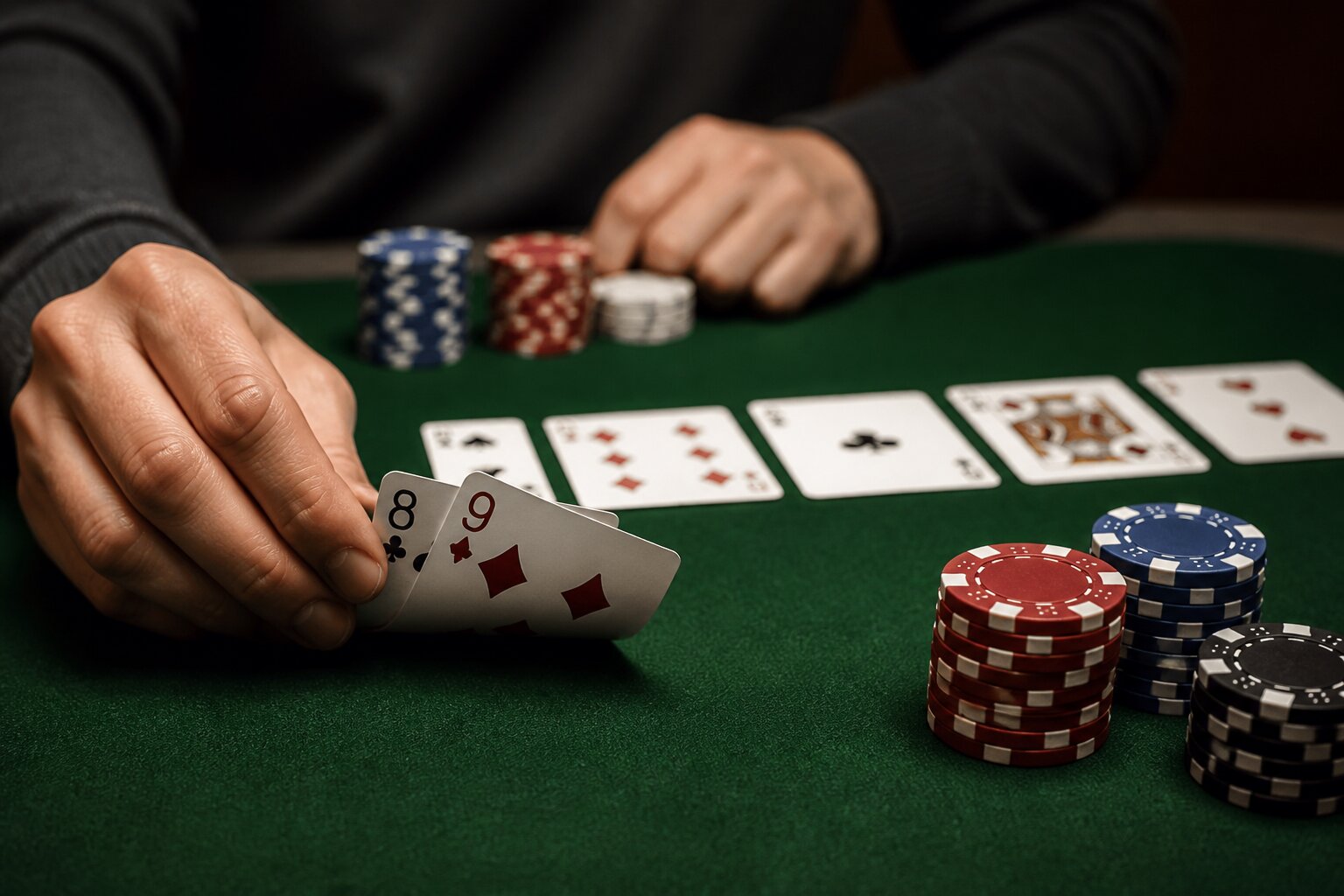
Few moments in poker are as tense as waiting for a single card to arrive. If you have felt that tight anticipation on the turn or river, you have a good sense of what chasing a gutshot straight draw feels like.
This term appears often at tables and in strategy conversations, but grasping what a gutshot is — and when it is worth pursuing — can sharpen your decisions and help you avoid costly mistakes. Let’s walk through what a gutshot draw is, how it differs from other straight draws, the maths behind it, and the practical choices it forces you to make.
What Is a Gutshot Straight Draw in Poker?
A gutshot straight draw, also called an inside straight draw, occurs when only one card value will fill a gap in the middle of your sequence and complete a straight. That single rank is the only way to make the five-card run.
For example, holding 5♥ and 6♠ with a flop of 4♣, 8♦ and Q♠ leaves you needing a 7 to form 4-5-6-7-8. No other rank will help. Because you depend on a single rank, gutshot draws present fewer possible completing cards than other straight draws.
Understanding this distinction matters at the table: a gutshot can produce big payoffs when it connects, but it is not as reliable as draws with more outs. Keep that balance in mind as you weigh whether to continue in a hand.
How Does a Gutshot Draw Differ from an Open-Ended Straight Draw?
Both gutshot and open-ended straight draws aim to make a straight, but they differ in how many cards can complete them.
A gutshot requires one specific card somewhere inside the sequence. An open-ended draw, by contrast, can be completed by either of two ranks at the ends of the sequence. For example, 5-6-7-8 can be finished with a 4 or a 9.
The practical consequence is simple: an open-ended draw usually offers about twice as many outs as a gutshot, which affects how attractive it is to chase. That difference in outs translates directly into different odds and therefore different strategic choices.
The Odds of Hitting a Gutshot Draw
When you have a gutshot in Texas Hold’em, there are typically four cards in the deck that will complete your straight. After the flop there are 47 unseen cards, so the chance of hitting on the turn is about 4 divided by 47, roughly 8.5%.
If the turn does not produce the card you need, another opportunity arrives on the river. The combined probability of hitting by the river is higher; in practical terms it works out to around 16.5%.
These percentages help frame your decisions. Rather than treating them as guarantees, use them as objective inputs when comparing the cost of staying in the hand to the potential reward.
Recognising Gutshot Draws at the Table
Spotting a gutshot is a matter of pattern recognition: check whether your current two-card hand and the community cards form a sequence with a single gap that only one rank fills.
For instance, holding 7♠ and 8♣ with a board of 5♦, 6♥ and Q♠ means only a 9 will complete a straight. Another example is holding 3♣ and 7♦ on a 4♠, 5♥, 9♥ board; a 6 is the lone card that would make 3-4-5-6-7.
When you see this, pause to assess the board texture and other players’ actions. Is the board paired, making full houses possible? Are opponents betting strongly in a way that suggests they already have a made hand? These contextual factors can change whether a gutshot is worth pursuing.
Why Is It Called a Gutshot?
The name comes from the idea that the needed card sits in the middle of the sequence — the “gut” — rather than at either end. Saying you have a gutshot communicates that you are drawing to an inside card, one that must fall between two of your existing cards to complete the straight.
This label is simply descriptive poker terminology. It allows players to describe hand types quickly and consistently at the table without implying anything about how likely the draw is to hit or what action should be taken.
Used in conversation and hand histories, the term helps players think about their holdings and discuss situations with others. It does not carry strategic baggage on its own; any decisions about betting, folding or calling depend on the specific context of the game, the stakes and the players involved.
Common Misconceptions About the Gutshot Draw
A few persistent myths can mislead players. One is overestimating how often a gutshot will connect; the four outs make it a relatively low-probability event. Another is treating a gutshot as a strong hand before it is completed. Until the card arrives, it is still a draw and vulnerable to stronger made hands.
Some believe that experienced players can always tell when someone is on a gutshot. While reads and patterns can suggest possibilities, they do not turn draws into certainties.
Recognising these misconceptions helps you approach gutshots with realistic expectations and make decisions based on maths and context rather than wishful thinking.
When Should You Consider the Gutshot in Your Calculations?
Deciding whether to continue with a gutshot usually comes down to comparing your chance of winning to the cost of calling. That means counting your outs and converting them into a probability, then matching that against the pot odds you are being offered.
Evaluating Pot Odds and Potential Payouts
Begin by identifying your outs — typically four for a gutshot — and use the known probabilities for turn and river outs to estimate your chance of completing the straight. Then look at the pot: how large is it relative to the bet you must call? If the potential return outweighs the risk implied by your completion chance, calling can be justified. If not, folding is often the prudent option.
Also consider factors beyond raw maths. If the board allows for possible higher straights or full houses, your completed straight might not be the best hand even if it arrives. Similarly, think about the tendencies of the players left to act; pot control and fold equity matter in real play and can change the calculus in marginal spots.
Summary: Key Points About Gutshot Straight Draws
Understanding gutshot straight draws helps you make clearer in-game choices and avoid common traps.
- A gutshot straight draw needs one specific card rank in the middle of the sequence to complete a straight.
- It differs from an open-ended draw by offering fewer outs, which affects the odds and strategic value.
- Hitting a gutshot on the turn is around 8.5% and about 16.5% by the river.
- Spotting a gutshot is straightforward, but context — board texture and opponents’ actions — is crucial when deciding how to play it.
- Avoid common misconceptions: a gutshot is a drawing hand, not a made hand, until the required card appears.
- Choices about chasing a gutshot should combine the mathematical odds with practical reads on the table and the size of the pot.
If you want to test these ideas in practice, try reviewing past hands and noting where a gutshot came into play and how the decision affected the outcome. Practising that kind of reflection will sharpen your judgment at the table. And remember to set sensible limits so the game stays an enjoyable pastime.
**The information provided in this blog is intended for educational purposes and should not be construed as betting advice or a guarantee of success. Always gamble responsibly.