
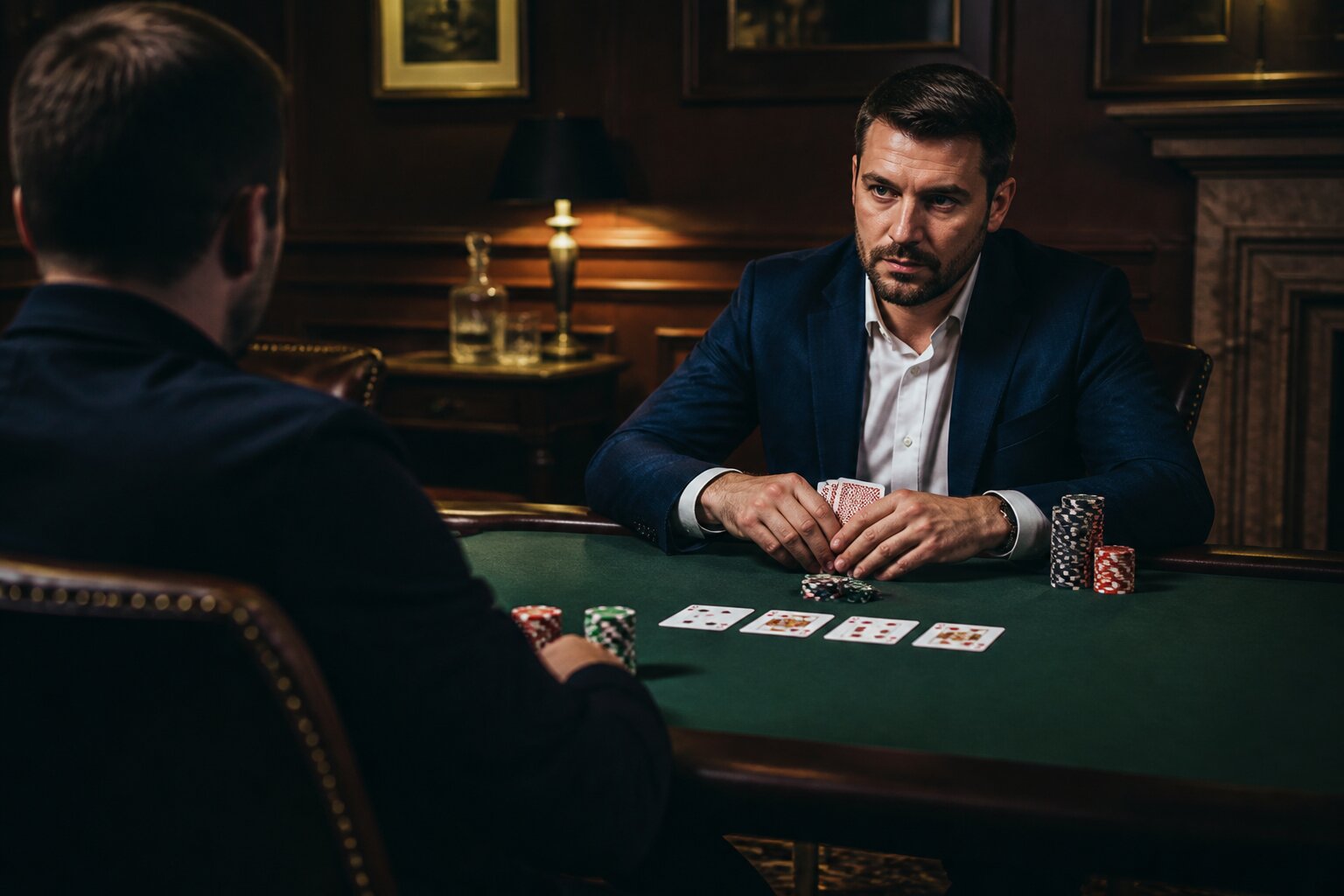
Fancy your chances in a poker showdown with just you and one opponent? Heads up poker is fast and intense—every decision matters from the first deal. The rules are familiar to anyone who knows Texas Hold’em, but the way you play them changes when the table shrinks to two.
If you want to sharpen your one-on-one game, this guide walks through the essentials: what makes heads up different, how play unfolds, common beginner mistakes, and practical tips to improve. Read on to build a clearer approach and feel more confident at the table.
What Is Heads Up Poker?
Heads up poker is the two-player form of poker where each hand is contested directly between just two people. There are no other seats to hide behind and every betting choice is immediately consequential.
Because there are only two players, position and aggression carry more weight than at a full table. You see more of your opponent’s actions and those actions tell a lot about their tendencies. Table talk and timing can also become tools in themselves, and small adjustments often have a large effect on outcomes.
The core mechanics are the same as in standard Hold’em, but the tempo and psychology shift noticeably. These shared elements include:
- hole cards
- community cards
- hand rankings
- betting rounds
In practical terms, heads up play tends to be faster and more dynamic. Players generally adopt wider starting-hand ranges and use more frequent aggression, including well-timed bluffs and semi-bluffs. Defensive play is less common because folding too often surrenders the initiative.
Heads up is also a high-variance format: short sessions can produce large swings, and results are influenced heavily by both skill and luck. It is often used to practise post-flop skills, exploit individual opponents, or settle short contests, but it is important to manage bankroll and avoid chasing losses.
How Do Heads Up Poker Rules Differ From Regular Poker?
Most rules carry over from full-table play, yet a few adjustments make the game run smoothly with only two players. The main differences concern the blinds and the order of action. In heads up, the dealer posts the small blind and the other player posts the big blind. The dealer acts first before the flop, then acts last on every later betting round. That swap balances positional advantage across hands.
These tweaks keep the structure familiar while ensuring fairness and flow in one-on-one play. Other components—hand rankings, betting rounds and wager types such as no limit or pot limit—work the same as in regular poker.
Essential Rules for Playing One-on-One Poker
This section summarises the practical rules you will encounter in every heads up match.
Blinds: The dealer posts the small blind and the opponent posts the big blind. These rotate after each hand so both players experience each position.
Dealing: Each player receives two private cards. Community cards are revealed in stages—flop (three cards), turn (one card) and river (one card).
Betting Rounds: There are four betting rounds. Players may check, bet, raise or fold depending on the situation and the structure of the game.
Hand Ranking: The usual poker hand hierarchy applies; the best five-card hand at showdown wins the pot.
Betting Structures: Games may be fixed limit, pot limit, or no limit. Know the format before you play so you can judge bet sizes accurately.
Rotation: After the hand completes, the dealer button moves and blinds are posted for the next hand.
Set a spending limit before you start and stick to it to keep play controlled and sustainable.
How Does Game Play Work in Heads Up Poker?
Heads up play tends to be brisk because each hand involves only two players, which makes it easier to follow betting patterns and read tendencies. A typical hand moves from pre-flop decisions through the flop, turn and river, with betting shaping the size of the pot and the information available to both players.
Pre-flop, the dealer acts first and choices here often set the tone: aggressive opening can seize initiative, while cautious play invites the opponent to lead. As community cards are revealed, decisions blend card strength with reads gathered from earlier behaviour. When betting ends, any remaining players compare hands and the highest-ranking five-card combination takes the pot.
Paying close attention to bet sizing and timing will give you insight into how your opponent approaches marginal hands and strong hands alike. That awareness lets you adapt your strategy as the match progresses.
The Role of the Dealer and Blinds in Heads Up Matches
The dealer role rotates every hand, which means the slight advantages of acting last on post-flop streets are shared across the match. The small blind is posted by the dealer, the big blind by the other player. Those forced bets create action and ensure there is always something at stake each hand.
Because the dealer acts first pre-flop but last afterwards, the position affects opening ranges and defensive postures differently across the hand. Experienced heads up players use this dynamic to vary aggression and to control pots when they have a positional edge.
What Common Mistakes Do New Players Make in Heads Up Poker?
Beginners often carry habits from full-table play that do not translate well to heads up. One frequent error is being too passive; with only one opponent, opportunities to take control of the pot arise much more often and passive play can let profitable hands slip away. Conversely, some players overplay weak holdings simply because the situation feels more confrontational; that invites losses when the opponent calls.
Failing to observe patterns is another common misstep. Since you see every action, ignoring those tells forfeits a strong source of information. Finally, poor bankroll control and emotional reactions to swings can end sessions quickly. Keeping a cool head and monitoring stakes ensures you can keep practising and improving.
Tips for Winning One-on-One Poker Matches
Winning heads up requires attention, flexibility and discipline. Start by learning your opponent’s tendencies and adjusting accordingly. If they fold frequently to aggression, value bets and occasional bluffing will be effective; if they call down a lot, tighten up and seek value with stronger hands.
Vary your approach so you are not easily predictable. Mix bet sizes and occasionally change opening ranges to make reads less certain. Manage your bankroll by choosing stakes that match your comfort level; this reduces pressure and helps you make clearer decisions.
Patience remains important: folding can be the better choice in many spots and preserving chips for advantageous situations is a hallmark of experienced players. Above all, maintain control over your emotions—decisions founded on frustration or impatience usually cost more than they gain.
These tips work best when balanced together rather than applied rigidly. Use them as a guide to shape your style and respond to how each opponent plays.
Are There Myths About Heads Up Poker You Should Ignore?
Several misconceptions can lead new players astray. One is the idea that you must bluff constantly to succeed. While well-timed deception is part of advanced play, an overreliance on bluffing becomes easy to counter. A better approach mixes selective aggression with clear value betting.
Another myth is that heads up is only for seasoned players. It is true that experience helps, but the format is also an excellent training ground: you face fewer opponents, learn to interpret behaviour faster, and gain a lot of hands in a short period. That environment can accelerate improvement when you study and reflect on your sessions.
Be sceptical of claims that promise easy shortcuts to consistent wins. Solid play evolves from understanding situations, adapting to opponents and making disciplined choices.
How to Prepare for Your First Heads Up Poker Game
Preparation focuses on understanding rules, gaining practical experience, and setting boundaries so your first match is constructive rather than stressful.
Learn the Rules
Make sure you are comfortable with how blinds, dealing and betting rounds operate in heads up play. Knowing the flow of a hand allows you to focus on strategy rather than mechanics.
Practise for Free
Use practice tables or free-play environments to get a feel for timing, bet sizes and opponent reactions. These settings let you try different approaches without risking money and reveal which tendencies you need to work on.
Set Your Limits
Decide in advance how much you will risk and what you will do if you reach that limit. Clear boundaries help prevent impulsive decisions and keep the experience under your control.
Stay Safe and Responsible
Keep sessions to a sensible duration and avoid increasing stakes when feeling stressed or tilted. If the game stops being enjoyable, step away. Playing in a measured and considered way helps you learn more and keeps poker a sustainable hobby.
If you want to get started now, try a low-stakes heads up session to test the ideas above and build confidence gradually. With practice and attention to how opponents react, your one-on-one game will become sharper and more rewarding.
**The information provided in this blog is intended for educational purposes and should not be construed as betting advice or a guarantee of success. Always gamble responsibly.