
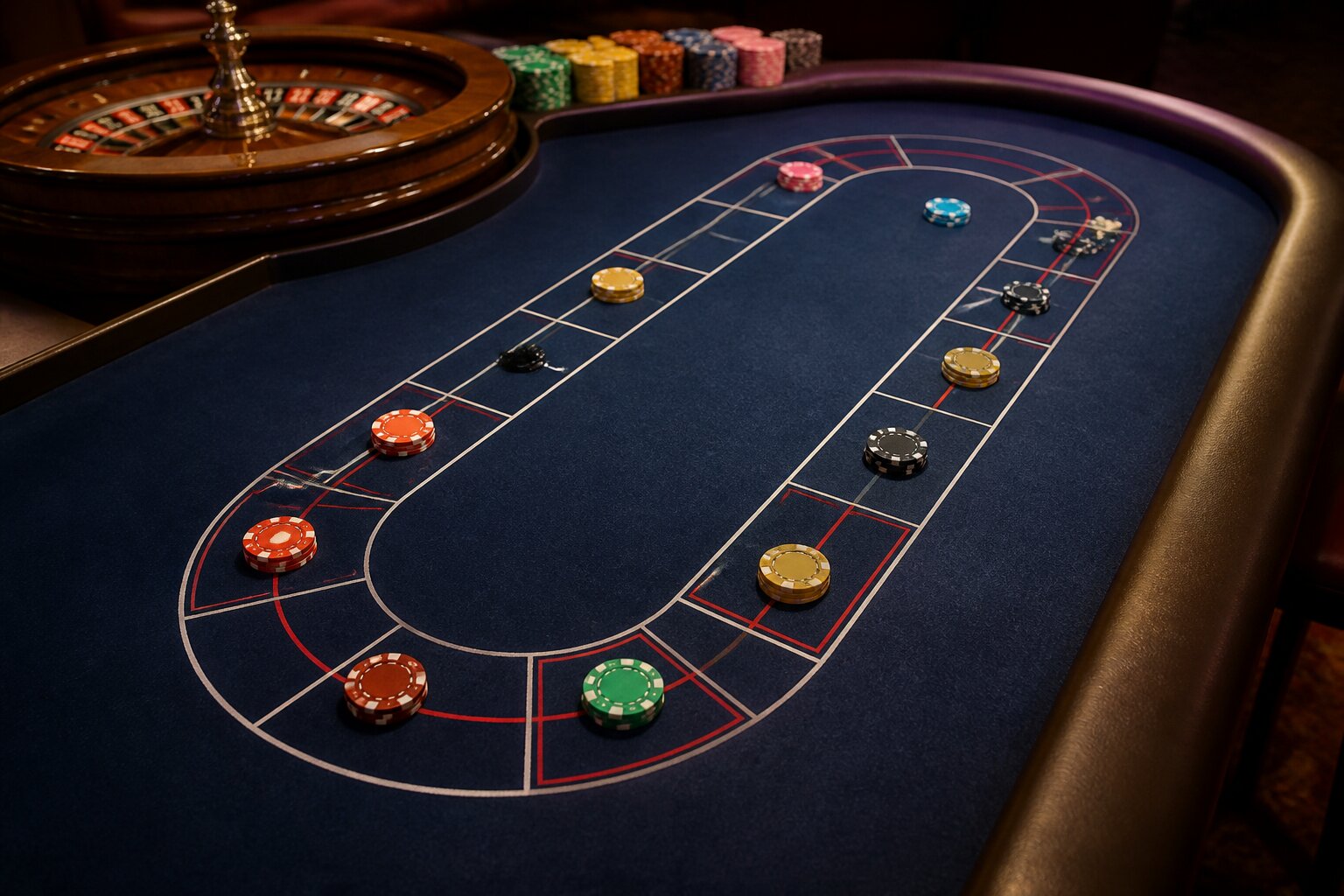
Ever wondered what that oval-shaped track is next to the main roulette betting area? If you’ve spotted players calling bets like “Voisins du Zéro” or “Tiers du Cylindre”, you’re not alone. The racetrack and its call bets can look baffling at first, but once you understand how they map to the wheel, they open up a new way to play.
This guide explains the racetrack, the common call bets, and how the layout links to the wheel — all in plain English. Whether you’re new to roulette or curious about adding variety to your play, you’ll find clear examples and useful context to build confidence at the table.
Read on to learn how the racetrack works and what each call bet covers, with practical pointers to help you bet more knowingly.
What Is the Roulette Racetrack and How Does It Work?
The racetrack is an oval section beside the main betting grid that represents the order of numbers on the roulette wheel. Unlike the rectangular table where numbers are arranged in rows and columns, the racetrack mirrors the wheel’s sequence so you can stake areas based on where numbers sit around the wheel.
It’s mainly used for call bets, sometimes called announced bets, which cover groups of wheel-adjacent numbers with a single wager. That makes placing several split and corner bets at once much quicker and visually clearer for both players and the dealer.
When you place chips on a labelled racetrack segment, the dealer or the game software covers each of the individual bets that make up that call bet. That saves you from placing multiple chips on the main grid and helps you target wheel-based sections instead of table-based groupings.
Understanding the Call Bets Layout on the Roulette Table
The racetrack is divided into labelled sections that match popular call bets. Each section corresponds to a set of numbers next to one another on the wheel, so the layout is organised by wheel position rather than numerical sequence.
This design makes it easier to choose the area you want to cover. For example, instead of placing a handful of split bets on the main grid, you place a single chip on the racetrack label and the game covers the required splits and corners automatically.
Using the racetrack is primarily about convenience and variety. It gives you a simple way to cover logical wheel segments, which can change how you think about your bets without changing the underlying mathematics of the game.
What Are Call Bets in Roulette?
Call bets let you cover specific clusters of numbers as they appear on the wheel. They act as a shorthand for placing several individual bets that together cover a continuous section or multiple sections of the wheel.
These bets are most common in European and French roulette. They are offered as a way to back wheel-based groupings rather than the table layout, which some players find more convenient. Call bets do not change the underlying house edge; they only make it quicker to place a number of related bets at once.
Neighbours
A Neighbours bet covers a chosen number plus a set number of neighbours on each side of it on the wheel. A typical "number plus two neighbours" covers five numbers in total, the chosen number and the two immediately either side on the wheel.
You can vary the number of neighbours on each side, so a player might choose just one neighbour each side or several, depending on how wide they want the coverage to be and how much they are prepared to stake.
Voisins du Zéro
Voisins du Zéro covers the 17 numbers closest to zero on the wheel. It is a broad section that sits around the zero pocket and is commonly backed with a mix of different bet types designed to cover that arc.
This combination typically includes:
- split bets,
- corner bets,
- straight bets.
The exact chip layout is standardised in many casinos, so dealers can place the correct mix of bets quickly when you call Voisins.
Tiers du Cylindre
Tiers du Cylindre, which translates as "third of the wheel", covers 12 numbers roughly opposite zero. It is usually placed using a series of split bets that together cover that one-third segment of the wheel.
Because the numbers are arranged on the wheel rather than the table, Tiers is a practical way to bet on a wheel-facing section without having to calculate and lay out many separate individual bets.
Orphelins
Orphelins covers the eight numbers that are not included in the Voisins or Tiers sections. These numbers sit in two separate fragments on the wheel and therefore require a slightly different chip arrangement to reach both groups.
Casinos typically provide a standard Orphelins layout so the dealer can place the necessary straight and split bets on both fragments quickly when the call is made.
How Do You Place Bets on the Racetrack?
Placing racetrack bets is straightforward whether you’re at a live table or using an online interface. The racetrack shows the labelled sections, so you select the segment and wager a stake that the dealer or the system distributes across the individual bets that make up that call bet.
For a Neighbours wager you may be offered options for how many numbers on either side of the chosen number you want to include. Online tools usually let you slide or select the neighbour count before you confirm your stake.
Before you place any bet, check the total stake that will be committed, since call bets often translate into multiple underlying chips. This helps you manage how much of your session bankroll is used in each round.
Visual Guide to the Racetrack and Table Layouts
The table has two visual tools for betting: the main grid and the racetrack. The main grid arranges numbers 0–36 in rows and columns and houses the familiar inside and outside bets: straight numbers, splits, streets, columns and reds/blacks or odds/evens.
The racetrack, positioned beside that grid, shows the wheel order. Each labelled segment corresponds to a collection of splits or corners that represent a continuous wheel arc. When playing online, both views are usually available so you can switch between betting by table position and betting by wheel position.
If you’re unsure at a live table, the dealer can point out which wheel numbers are covered by a racetrack label. That quick visual comparison helps link the oval track to the actual wheel layout and makes the betting choices clearer.
Roulette Racetrack Versus Traditional Table: What’s the Difference?
The essential difference is how numbers are grouped for betting. The traditional table shows number order for straightforward inside/outside bets and is ideal for single-number plays or simple combinations like columns and dozens.
The racetrack groups numbers by wheel adjacency, making it easier to place more complex wheel-based wagers in one move. It doesn’t offer better odds, but it does change how you approach coverage: one is table-centred, the other wheel-centred.
Many players mix both types of bets in the same round to create a preferred coverage pattern. Whichever approach you use, being clear about your stake and how many underlying bets it creates keeps play transparent and manageable.
Common Myths About Roulette Racetrack Betting
There are a few persistent misunderstandings about the racetrack that are worth correcting.
One is the idea that using the racetrack improves your chances of winning. The mechanics of the wheel and numbers remain the same; the racetrack is simply a different method of placing bets, not a way to alter outcomes.
Some people claim specific call bets perform better than others. Because every spin is independent and each pocket is equally likely to be the result, no one section is inherently more likely to come up than another.
Another mistaken belief is that past spins create predictable patterns you can exploit. Results are not influenced by previous outcomes, so relying on streaks or patterns is not supported by how the game works.
Clearing up these myths helps keep expectations realistic and focuses attention on understanding what each bet covers rather than chasing perceived shortcuts.
Roulette Racetrack Betting: Key Terms Explained
Understanding a few key terms makes racetrack betting easier to follow. Each term refers to how bets are grouped by their position on the wheel rather than by the layout on the table, which helps when placing so-called call bets at the racetrack area.
Racetrack
The oval section showing numbers in wheel order used to place call bets. It mirrors the sequence of numbers around the physical wheel and lets players point to wheel-based groupings without marking the table layout.
Call Bets
Wagers that cover groups of numbers defined by their position on the wheel. These are typically announced to the dealer or placed on the racetrack diagram and can cover large sections of the wheel more quickly than individual chips on the table.
Voisins du Zéro
A bet that covers the 17 numbers adjacent to zero on the wheel. It spans a substantial arc around the wheel and is often placed as a combination of chips on various splits, streets and corners that correspond to those wheel slots.
Tiers du Cylindre
A bet covering 12 numbers roughly opposite zero, usually placed as a set of splits. This segment is commonly bet as six split bets and is intended to cover the side of the wheel farthest from the zero section.
Orphelins
A bet covering the eight numbers not included in Voisins or Tiers, split across two wheel fragments. Players typically place this as a mix of single numbers and split bets to cover the remaining gaps.
Neighbours
A wager that covers a chosen number plus numbers adjacent to it on the wheel, often two on each side. Players can specify how many neighbours to include, for example one neighbour either side or two neighbours either side, and the bet is arranged as a series of splits and straight chips corresponding to those wheel positions.
These terms are practical labels for the kinds of coverage you can place and make it simpler to communicate your bets at the table. They describe where chips are effectively covering the wheel and help dealers and other players understand the scope of a call bet without needing to point to individual table bets.
FAQs on Roulette Racetrack and Call Bets
Below are answers to frequently asked questions that often come up when learning about the racetrack and call bets.
Are racetrack bets available in all types of roulette?
Racetrack and call bets are most commonly offered in European and French roulette. They may not be present in every variant, so glance at the table or game rules before you begin.
Do call bets improve my odds of winning?
No type of bet changes the underlying probabilities of the wheel. Call bets simply let you cover particular wheel sections more efficiently.
How do I place a Neighbours bet online?
Select the racetrack view, pick the target number and choose how many neighbours to include. Confirm the stake and the system allocates the underlying bets automatically.
Is it more expensive to place call bets?
Because call bets cover several numbers, they translate into multiple sub-bets and therefore a higher total stake. Check the aggregate stake before confirming to manage your session limits.
Can I mix racetrack and table bets in one game?
Yes, you can combine both types of bets in the same round as long as your total stake remains within the table limits.
Thanks for reading. If you’d like to try call bets on our tables, use the racetrack view to explore the sections mentioned here and see how different combinations cover the wheel — it’s a clear way to compare options and choose what suits your approach.
**The information provided in this blog is intended for educational purposes and should not be construed as betting advice or a guarantee of success. Always gamble responsibly.