
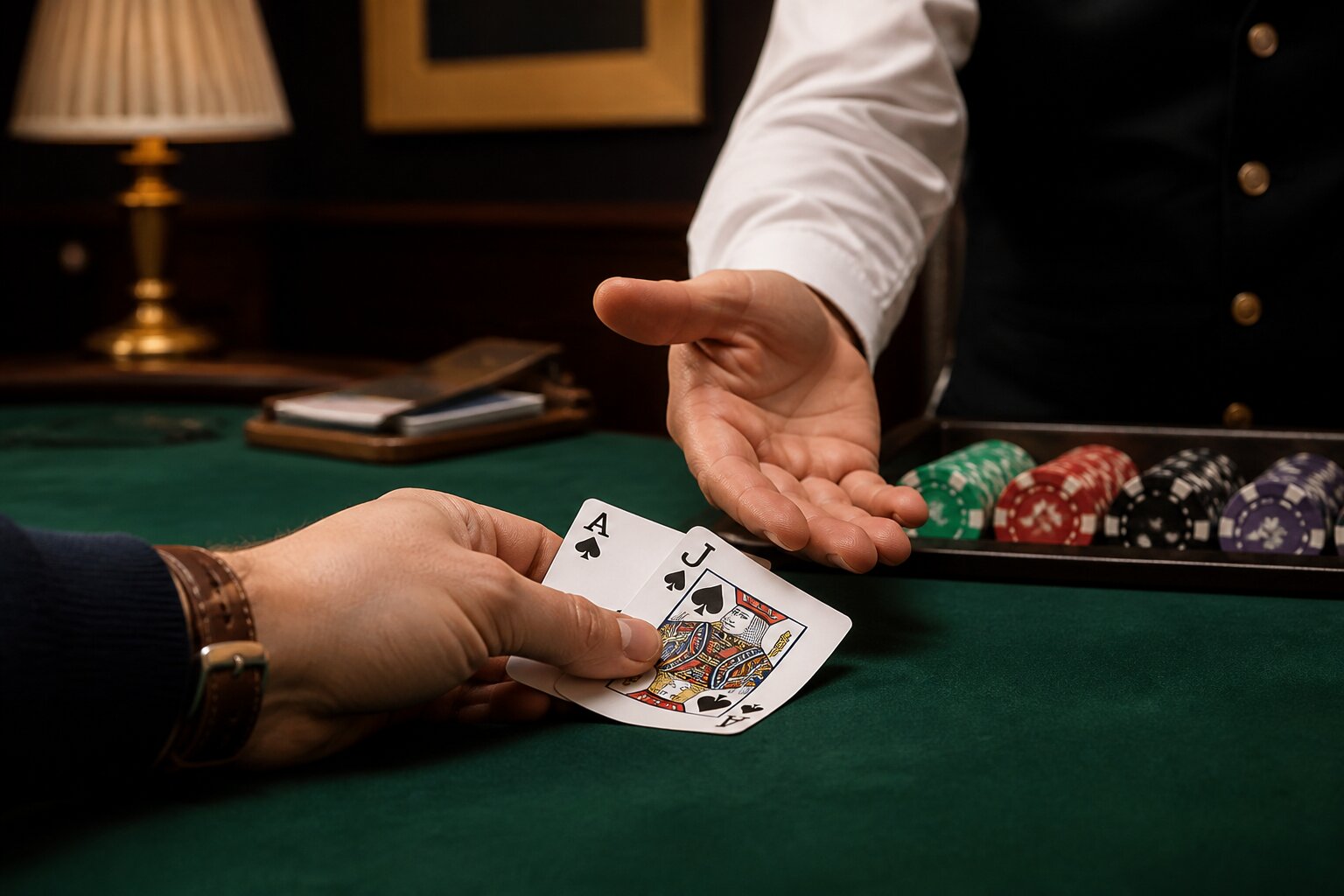
If you’ve played blackjack in a casino or online, you might have been offered “even money” when you hit a blackjack and the dealer is showing an Ace. It sounds tempting — a guaranteed payout right away — but is it the smartest choice?
Players are often divided: some accept it instinctively, others refuse every time. The reason for the split is a mix of simple maths, table psychology and how much certainty you value in a single hand.
Read on and you’ll understand exactly what even money is, how it affects your payouts, and when it might make sense to accept it or decline.
What Does Even Money Mean in Blackjack?
Even money is the option presented when you have a natural blackjack, which is an Ace and a 10-value card, and the dealer’s upcard is an Ace.
If you accept even money, the dealer pays you 1:1 immediately, matching your original stake in winnings. For a £10 bet that means an extra £10 on the spot. If you decline, the dealer checks for blackjack. If the dealer also has blackjack, the hand is a push and you simply keep your stake. If they do not, your blackjack pays the standard 3:2, which for a £10 bet would be £15.
In practical terms, taking even money is equivalent to taking insurance on your blackjack. It trades the chance of the larger 3:2 payout for the certainty of a smaller 1:1 payout on that single hand.
How Does the Even Money Option Work at the Table?
When the dealer offers even money, it occurs before further cards are revealed or play continues. Saying yes results in immediate payment at 1:1. Saying no means the dealer will check the hole card. If there is no dealer blackjack, your blackjack will pay at 3:2.
Not every game makes the option explicit in the same way, so it helps to know the house rules before you sit down. Online games and live tables sometimes handle the timing and phrasing differently, but the underlying choice and payouts remain the same.
Now that you know the mechanics, the next question is whether that guaranteed payout is worth taking.
Is Taking Even Money Always the Best Choice?
Even money offers certainty, but certainty comes at a price. From a value perspective, turning down even money is usually better over time because the dealer will have blackjack less than half the time when showing an Ace. That means most of the time your blackjack would be paid at the richer 3:2 rate.
Accepting even money reduces the expected return on each blackjack you play. It does not change the rules of the game, but it does change the distribution of payouts in your favour on that single hand and against you over many hands.
Whether that trade-off is acceptable depends on how you balance the desire for immediate, guaranteed payout against the aim of getting the higher statistical return in the long run.
Why Do Casinos Offer the Even Money Bet?
Casinos offer even money as an option because it smooths payouts and gives players a clear choice in the moment. For the operator, the guaranteed 1:1 payment shifts some of the variance away from a potential push and into a small, consistent concession.
Rather than being a favour, even money is simply another rule that maintains the overall balance of the game. It gives players an alternative when the dealer shows an Ace, and over many hands the structure of payouts keeps the expected returns aligned with the house edge.
Knowing this helps you see the option as part of the game’s design, not a special advantage.
Common Myths About Even Money in Blackjack
There are a few persistent misconceptions that confuse new players. One myth is that even money is always the smarter move. In truth, it lowers your average payout compared with declining and taking the standard 3:2 when the dealer does not have blackjack.
Another is that even money is a different thing to insurance. They are essentially the same concept applied in slightly different wording: a guaranteed smaller payout when the dealer’s upcard suggests a possible blackjack.
Some players also think even money protects them in the long run. It reduces volatility for that single hand, but it does not change the expected outcome across many sessions.
Clearing up these ideas helps you make a more informed choice when the option appears.
When Might Taking Even Money Be a Good Idea?
Even money can make sense for certain players and situations. If you prefer the psychological comfort of a definite win on that hand, or you are leaving the table soon and want to lock in a small profit, accepting even money is understandable.
It can also be reasonable if you are managing a tight budget for a single visit and want to eliminate the risk of a push affecting your immediate session balance. In such cases the value is not purely mathematical but practical and personal.
The key point is that the choice is about preference. Some players favour the safety of a guaranteed payout in the moment, while others prefer the greater expected return over many hands.
How Does Even Money Affect Your Winnings in the Long Run?
If you routinely accept even money, you will reduce your average return from blackjacks because you forfeit the extra half of the 3:2 payout most of the time. Since the dealer has blackjack less than half the time when showing an Ace, the expected value of declining the offer is higher.
Repeatedly taking even money increases the proportion of your winnings paid at 1:1 rather than 3:2, and that difference compounds over many hands. While the change per hand is modest, it becomes noticeable over extended play.
This is why experienced players who focus on maximising expected value generally decline even money, accepting occasional pushes for a chance at the larger payout.
What Do Experienced Blackjack Players Recommend?
Experienced players typically recommend declining even money on value grounds. They favour decisions that yield a higher expected return over many hands, accepting that this means occasional tied hands when the dealer also has blackjack.
However, seasoned players also recognise the personal element. Some will accept even money if it fits their session goals, bankroll constraints or if they prefer less suspense at the table. In short, experts advise understanding the maths but choosing the approach that aligns with your objectives.
If you want to mirror experienced play, prioritise expected value. If you want simpler, immediate outcomes, taking even money is a defensible choice for single-hand certainty.
Summary: Should You Take Even Money or Not?
Taking even money trades a higher possible payout for a guaranteed smaller one on a single hand. Mathematically, declining the offer is generally better over time because the dealer will have blackjack less often than not when showing an Ace. That leaves the 3:2 payout as the superior long-term return.
At the same time, personal preference, session goals and bankroll management are valid reasons to accept even money in specific situations. There is no universally correct answer, only the one that fits your approach to play.
Play within your means, set limits before you sit down, and choose the option that keeps the game enjoyable for you while respecting how you manage your money.
**The information provided in this blog is intended for educational purposes and should not be construed as betting advice or a guarantee of success. Always gamble responsibly.