
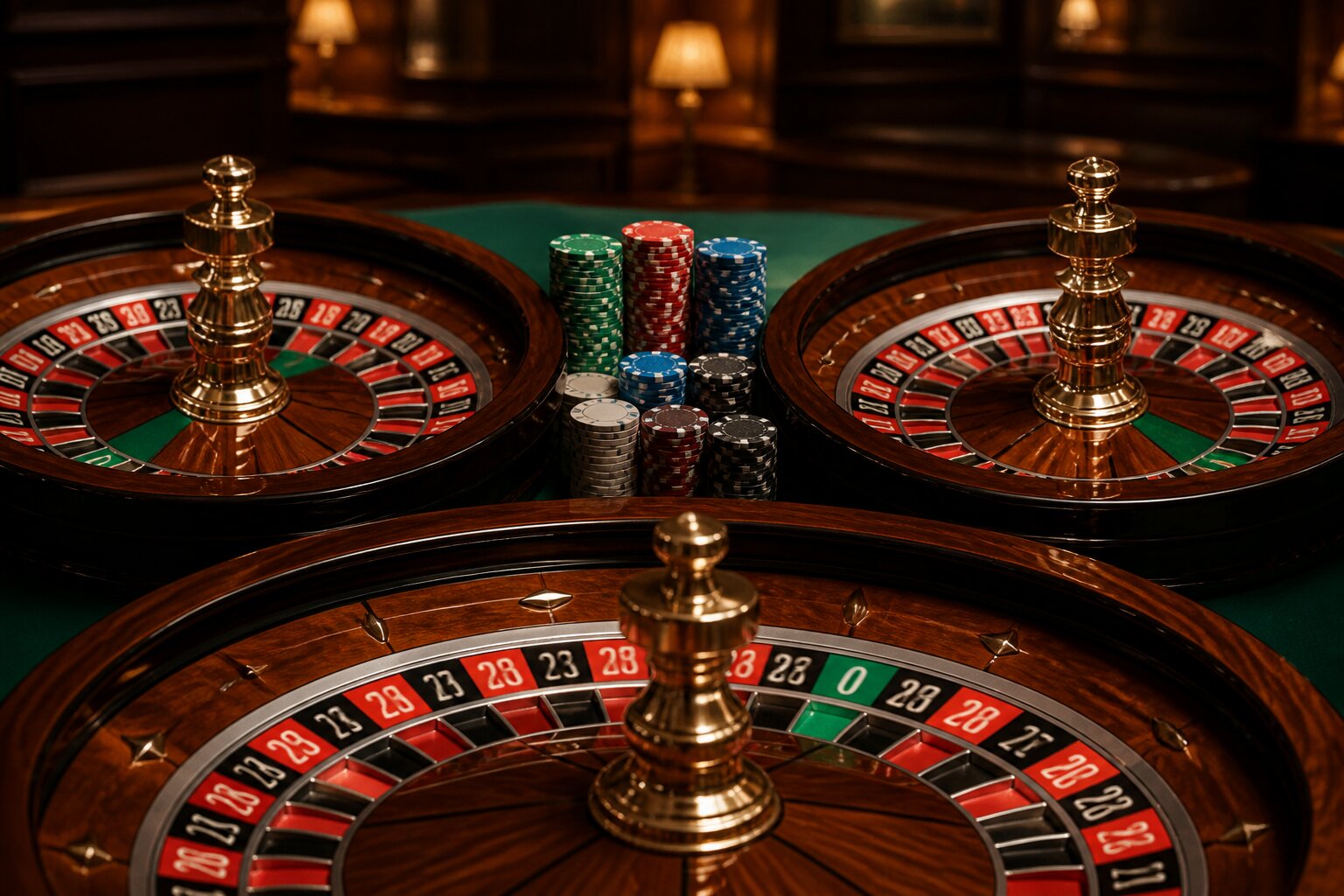
Thinking of spinning the roulette wheel but unsure whether to pick single zero or double zero? You are not alone—many players want to know which version gives better statistical odds and steadier returns. The difference between one green zero and two may seem small, yet it changes the probabilities behind every bet.
This article explains how each wheel is built, how the house edge works, and why identical payouts can still favour one version over the other. Read on to see which wheel tends to stretch playing time and how to choose the table that fits your approach.
What Is the Difference Between Single Zero and Double Zero Roulette?
Single zero roulette features a wheel with 37 pockets numbered 1–36 plus a single green zero (0). The table layout matches that arrangement, with one zero box at the top of the grid.
Double zero roulette has 38 pockets: numbers 1–36 plus both a single zero (0) and a double zero (00). The extra green pocket is reflected on the table by two separate zero spaces.
Structurally, the only difference is the extra zero pocket. That single addition increases the number of possible outcomes on each spin from 37 to 38, and this small change is what alters the game’s mathematics and, ultimately, the house advantage. This sets up a clearer look at how the house edge is calculated and why it matters for every bet you place.
Understanding the House Edge in Roulette
The house edge is the percentage of all stakes that the casino expects to retain over time because payouts are set slightly below true odds. In roulette, this shortfall comes from the green zero pockets, which are neither red nor black and do not count as part of even-money outside bets.
Single zero roulette carries a house edge of around 2.7%. Double zero roulette increases that edge to approximately 5.26% because the extra zero makes losses on many bets more likely. To see how this plays out, consider the following: an even-money outside bet (for example, red) wins on 18 numbers in single zero roulette, so the chance of success is 18/37, or about 48.65%. With the extra zero, that chance falls to 18/38, or about 47.37%.
Translating these probabilities into expected returns shows the practical effect of the house edge. If a player places repeated identical bets, the higher-edge game will, on average, erode the player’s stake faster. This difference does not change the short-term excitement of any particular spin, but over hundreds or thousands of spins the mathematical advantage becomes measurable. Next, we will consider how the published payouts relate to those probabilities.
Payouts: How Do They Differ Between Single Zero and Double Zero?
Standard payout schedules are the same in both versions of roulette. Bets are paid according to fixed ratios that remain constant whether the wheel has one green pocket or two.
Analysis of Standard Bet Payouts
Below are the conventional payouts you will see at the table, shown after a short explanation of bet types so the list reads clearly.
Straight up (single number): 35 to 1
Split (two numbers): 17 to 1
Street (three numbers): 11 to 1
Corner (four numbers): 8 to 1
Dozens or Columns: 2 to 1
Red/Black, Odd/Even, High/Low (outside bets): 1 to 1
These payouts do not compensate for the differing number of pockets. Because the chance of a straight up win is 1/37 in single zero and 1/38 in double zero, the identical 35 to 1 payout becomes slightly less favourable on the double zero wheel. The same logic applies to every bet: the relative probability changes while the payout stays fixed.
Impact on Player Returns Over Time
When payouts are unchanged but probabilities shift, the expected return per bet changes. For example, a straight up bet on a single zero wheel provides a theoretical return closer to the true odds than the same bet on a double zero wheel. Over many bets, the cumulative effect shows as a larger average loss on the higher-edge game.
This explains why some players prefer tables that include rules like La Partage or En Prison, which can partially offset the zero’s impact on even-money bets. With that in mind, the next section looks at which version tends to be better for players in simple probabilistic terms.
Which Version Offers Better Odds for UK Players?
From a purely statistical perspective, single zero roulette gives slightly better odds for every standard bet because there is one fewer non-winning pocket. The difference is small on any single spin but becomes meaningful across many spins.
For a straight up bet the chance of winning is 1/37 in single zero and 1/38 in double zero. For even-money bets the chances are 18/37 versus 18/38 respectively. These differences produce the house edges already noted: roughly 2.7% for single zero and 5.26% for double zero. In plain terms, choosing single zero reduces the average percentage of stake lost over the long run.
Beyond pure percentages, table rules and side options matter. French roulette variants may offer La Partage or En Prison rules that lower effective losses on even-money bets, and some operators publish return-to-player figures or volatility indicators that help decide which tables better suit a given approach. If you prefer steadier, slightly stronger odds, a single zero or a French table with one of those rules will typically be the better match. The following section explains how to spot these games online and what to look for before you play.
Choosing the Right Roulette Table Online
Most online casinos label tables clearly: single zero games are usually called European or French roulette, while double zero tables are shown as American roulette. Game descriptions or the visual wheel image will confirm the number of pockets if the label is not explicit.
Before committing real money, review the table layout and any listed rules. Look for mentions of La Partage or En Prison, the number of pockets, and whether the game shows a theoretical return-to-player percentage. Also check bet limits and the clarity of the interface so you can place bets confidently.
Operators commonly provide player controls and account tools to help manage play. Use deposit limits, loss limits and session reminders if you want to keep gaming within a set framework. If you prefer a lower statistical disadvantage and slightly longer expected play per stake, single zero or French roulette with favourable rules is usually the better choice.
If you would like to try a lower-house-edge option right away, try our single zero tables to see how they feel.
Play Casino Games Online at Dove Casino
Ever fancied exploring what an online casino has to offer in a safe and welcoming setting? With our site, you can enjoy the experience from the comfort of your own home, whenever it suits you.
**The information provided in this blog is intended for educational purposes and should not be construed as betting advice or a guarantee of success. Always gamble responsibly.