
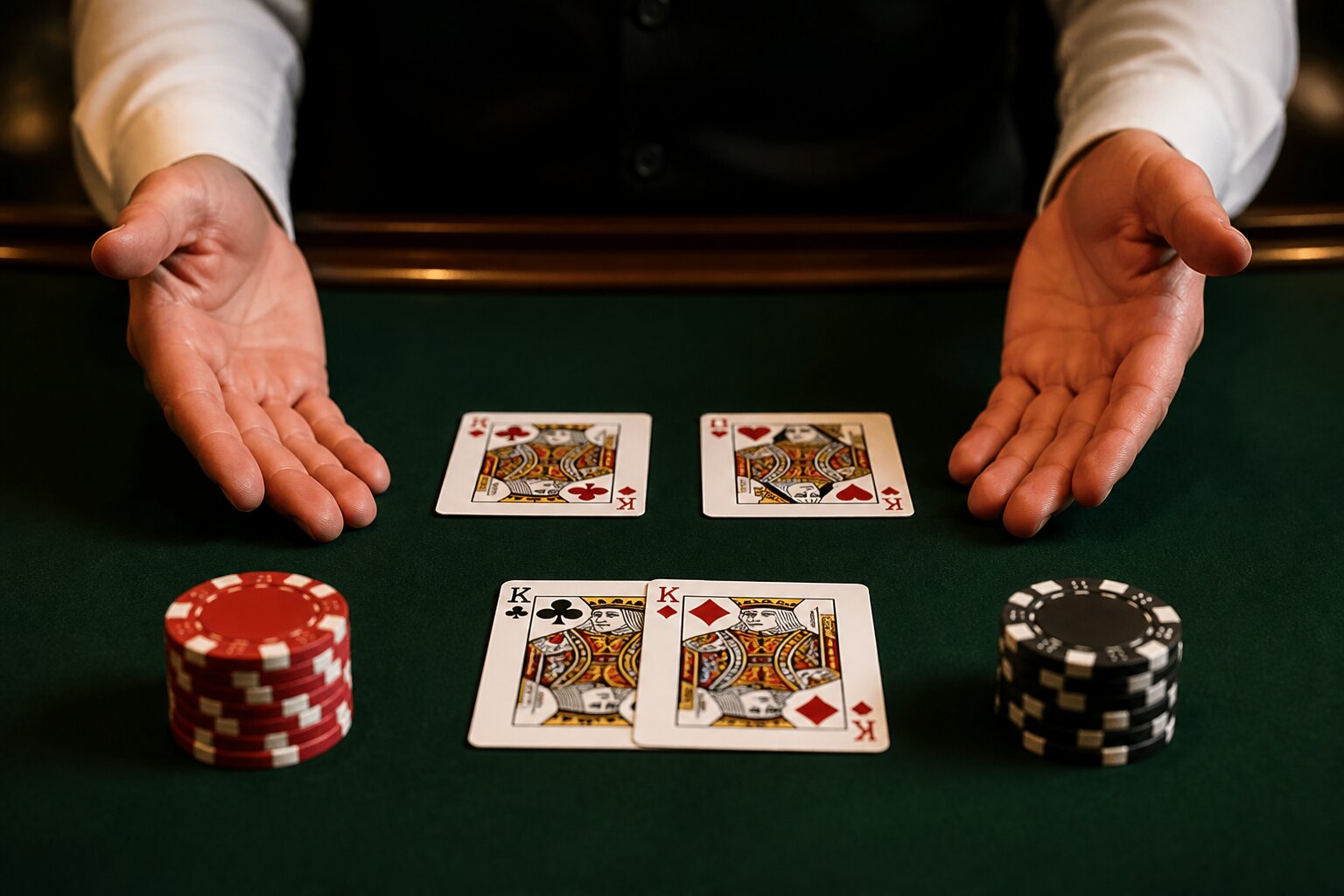
Ever been at a blackjack table and heard the dealer call a "push"? It’s a common outcome that can catch players off guard, especially if you're new to the game. This article explains what a push actually is, how it affects your bet, and how it’s handled in different versions of blackjack so you know what to expect next time you play.
Whether you play in a casino or online, knowing how ties are resolved keeps the game clearer and helps you make better decisions. Read on to understand the rules and typical scenarios where a push might occur.
What Is a Push in Blackjack?
A push happens when your final hand total is exactly the same as the dealer’s once a round is complete. In that case neither side wins, and the round ends as a draw.
When this occurs your original stake is returned. You don’t receive a payout, but you also don’t lose the bet you placed for that hand. It is simply treated as if that particular wager had not produced a profit or a loss.
Pushes occur fairly often because both player and dealer aim for the highest hand not exceeding 21. Any matching final totals—from 18 up to 21—result in a push provided neither side has busted.
Because the outcome depends only on the final totals, it does not matter how you or the dealer reached that number. Whether you stood on two cards, hit several times or doubled down, if the totals match when the round ends, the result is a push.
How Does a Push Affect Your Winnings?
In the event of a push you get your stake back, so your available balance returns to what it was before that bet. There is no profit and no loss from that single hand.
This outcome can be useful strategically in that it preserves bankroll when the round does not go clearly for either side. It also means that streaks of pushes will not change your balance directly, though they do affect how many winning hands you need to reach a target profit.
Think of a push as a pause rather than a setback: your funds are intact and you can choose whether to place the same bet again, increase it, or stop playing. Keep in mind the rules of the specific table or game you are at, as they determine how bets are handled during and after a round.
Tie Outcomes: When Do They Occur?
A tie, or push, can occur in several common situations. The simplest is when both you and the dealer finish with an identical numerical total that does not exceed 21—18, 19, 20 or 21 are typical examples.
Ties also cannot happen if one side busts. If the player goes over 21, the hand ends as a loss regardless of the dealer’s eventual total. Similarly, a blackjack—a two-card 21 that includes an Ace and a ten-value card—will beat a dealer’s non-blackjack 21 and is not a push.
Other situations that can result in a push include when both the player and dealer have hands created by multiple cards adding to the same value, or when both have the same total after doubling down or splitting hands. The key point is the final total, not the route taken to reach it.
If you want to anticipate the most likely tie scenarios, look at hands where both sides stand on middle totals such as 17 to 20. These are where equal values crop up most frequently, since neither side is automatically forced to draw further cards.
What Are the Dealer’s Rules During a Push?
When a push is identified, the dealer follows the established procedure for that table. The dealer will announce the result, collect any losing bets, and return the stakes for hands that have pushed.
Dealers operate under fixed rules that govern how they act during a round and how outcomes are resolved. They have no discretion to alter the resolution of a push; returning the original stake is part of the standard set of procedures.
After the push is settled, the table proceeds to the next round as normal. If you’re playing in person you will receive your chips back; in an online game the system will credit your account automatically. If anything is unclear at the table, asking the dealer for a brief clarification is perfectly acceptable.
What Happens to Your Bet on a Push?
Your bet is returned in full when a push occurs. Physically that means chips are slid back to you at a land-based table; digitally it means a credit to your account balance in an online game.
No additional money is paid out and no fee is taken for that round. The returned stake can be used for the next hand or withdrawn if you choose. This straightforward handling is intended to keep the game transparent and fair for players.
Knowing this makes it easier to understand your session’s flow: pushes pause any net change to your bankroll, while wins and losses change it. That distinction can help you plan how many hands you’d like to play within a given budget.
Difference Between a Push and a Win or Loss
- A win increases your balance because you receive your stake plus a payout determined by the game’s rules.
- A loss removes your stake from your balance.
- A push differs because it leaves your balance unchanged; your stake is returned and no payout is awarded.
A push is a neutral outcome rather than a positive or negative one. It still counts as a completed round, but because your money is simply returned, it does not move your balance up or down. This can affect short-term volatility, making a session feel steadier than one with the same number of wins and losses but fewer pushes.
Understanding pushes helps with bankroll management and with setting expectations during play. Players may find that many pushes mean fewer net-changing results, so:
- fewer wins may be needed to reach a target balance because fewer losses occur to offset them, or
- wins may seem less frequent because many rounds do not alter the balance.
Recognising this behavioural difference supports clearer tracking of performance in a session and encourages realistic planning about how outcomes will affect your funds and your experience. Remember to play responsibly and within your limits.
Do All Blackjack Variations Handle Pushes the Same Way?
Most standard blackjack games return the original stake in the event of a tie, but some variants and side bets can bring different mechanics into play.
Certain blackjack versions add optional wagers or special rules that can alter outcomes around ties—for example, side bets that pay out on particular card combinations regardless of the main hand result. Other tables might have slight differences in payout ratios for blackjacks versus regular wins, which affects overall session results but does not usually change the basic treatment of a push.
Before you play a new variant, it is sensible to check the game rules displayed at the table or in the game interface. That way you know whether any special conditions apply to pushes or to related side bets.
Common Myths About Pushes and Ties in Blackjack
There are a few persistent misunderstandings about pushes. One is that a push signals a mistake by the player. In reality it simply reflects matching final totals and is a normal part of play.
Another myth is that pushes indicate unfair play. Licensed operators and regulated tables are subject to oversight to ensure the rules are applied consistently. A push is not evidence of anything untoward; it is the game resolving a tie.
Some players believe tactics can force or avoid pushes. While playing choices affect hand totals, the final result still depends on the cards dealt and the dealer’s mandated actions, so no strategy guarantees specific tie outcomes.
If you find yourself puzzled by a repeated pattern of ties, review the specific rules at your table and consider small adjustments to your approach rather than assuming anything irregular.
Pushes in Online vs. Land-Based Blackjack
Whether you are playing in a physical casino or on an internet platform, pushes are resolved in much the same spirit, though the mechanics differ slightly.
In land-based play the dealer announces the push and returns chips at the table so everyone can see the outcome. This makes the resolution immediate and transparent for players seated around the table.
Online, the game engine recognises the tie and credits your balance automatically. The interface usually displays a message confirming the push and then moves on to the next hand without delay.
Understanding these practical differences helps you follow the game comfortably in either setting. Wherever you play, keep to the limits you have set for yourself and make decisions that suit your budget and enjoyment.
**The information provided in this blog is intended for educational purposes and should not be construed as betting advice or a guarantee of success. Always gamble responsibly.