
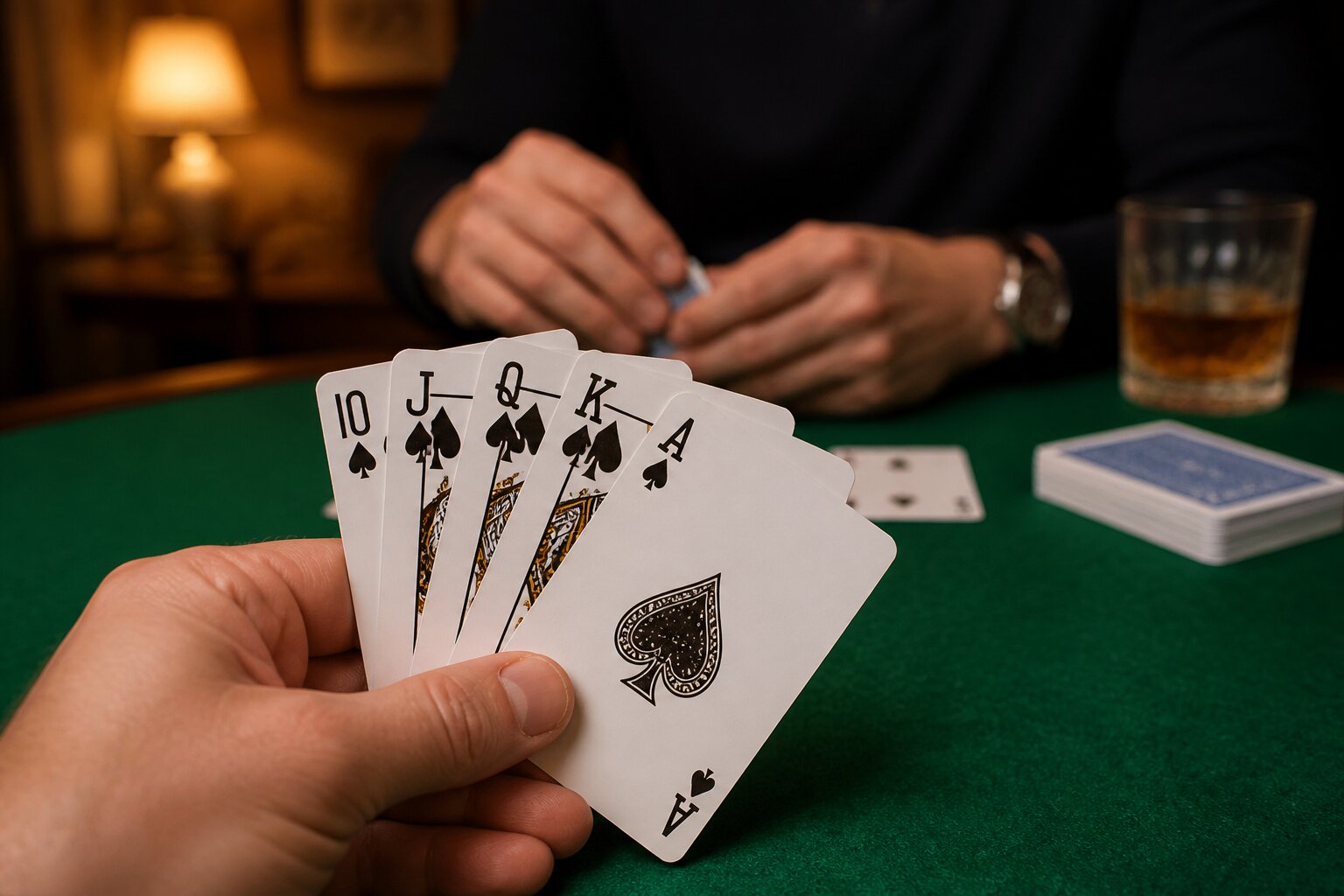
Fancy a thrilling card game that’s easy to pick up, fast-paced and full of strategic choices? Pontoon is a British casino classic that shares a family resemblance with Blackjack but plays distinctly.
This guide covers the core rules, how a typical hand unfolds and clear examples to bring the game to life. Read on and you’ll quickly see what makes Pontoon rewarding to play and watch.
What Is Pontoon?
Pontoon is a traditional British card game derived from the old French game vingt-et-un, which means “twenty-one.” The objective is straightforward: form a hand whose total is as close to 21 as possible without exceeding it. The single strongest hand is the Pontoon—an Ace together with any 10-point card—and it outranks all other combinations.
Several features distinguish Pontoon from other 21-style games. The dealer’s cards are dealt face down and remain hidden until the end of the round, which adds suspense and affects players’ choices. The game also uses its own terms: players “twist” to take another card, “stick” to keep their total, “buy” when they take another card while increasing their stake, and “split” when they divide a pair into two hands. These differences shape strategy and pacing, and lead naturally into how many people typically play at a table.
How Many Players Can Play Pontoon?
Pontoon requires at least two participants: one dealer and at least one player. Home games commonly have three to eight players, while casino-style tables often seat up to seven. Online tables may vary but typically follow the same range. In most settings a single dealer handles the entire table, so the practical limit is set by how many hands the dealer can manage comfortably.
The number of players mainly affects round speed rather than the mechanics of play. With more players, each round takes longer because every player makes decisions in turn. That slower rhythm can change the flow of the game, influencing choices such as whether to buy extra cards or split pairs.
Player count also affects how often the deck or shoe is reshuffled. Larger games tend to go through more cards between shuffles, which can alter the timing of reshuffles and the predictability of remaining cards. These are practical considerations rather than changes to the rules, and they can influence how the table feels from one session to the next.
Pontoon Card Values & Deck Setup
Pontoon usually uses a standard 52-card deck; when more players join, two or more decks are commonly shuffled together. Card values are simple and familiar:
- Number cards (2–10): face value.
- Face cards (Jack, Queen, King): 10 points each.
- Ace: either 1 point or 11 points, whichever benefits the hand.
Suits do not change card value and there are no jokers. The hand’s total is the sum of the cards, and players aim to get as close to 21 as practical without exceeding it. Knowing how the Ace flexes between 1 and 11 is often central to choosing whether to twist, stick or buy, and it plays into the special hands explained next.
How Do You Win at Pontoon?
Winning in Pontoon depends on having a stronger valid hand than the dealer at the end of the round. The ranking of hands from strongest to weakest is:
- Pontoon: an Ace plus a 10-point card (two-card 21).
- Five-card trick: five cards whose total is 21 or less.
- Any 21 made with three or more cards.
- Any total below 21 that is closer to 21 than the dealer’s total.
If your hand exceeds 21, it is a bust and you lose that bet immediately. When both dealer and player end on the same numerical total, the outcome is determined by hand type rather than tieing purely on numbers—so a five-card trick beats a standard three-card 21, for example.
Payouts and exact ordering of outcomes can vary between houses, but the hierarchy above reflects the usual priority of special hands over ordinary totals. Understanding these rankings helps when deciding whether to take an extra card or accept a given total.
Playing a Hand of Pontoon
Below is an explanation of how a typical round proceeds, highlighting player choices and how the dealer completes the hand. Pontoon is for adults only; play must always stay within personal limits.
The Initial Deal
Each player places a bet and the dealer deals two cards face down to everyone, including themselves. Players look at their own cards privately but do not reveal them. The hidden dealer hand remains concealed until players have finished their decisions, which increases the psychological tension in play.
Player Actions: Twist, Stick, Buy, Split
After the initial deal, players decide how to proceed for their hand:
- Twist: take another card to increase the total. This is used when the current total is judged to be too low relative to the perceived dealer risk.
- Stick: stop taking cards and accept the present total.
- Buy: request another card while increasing the wager; the bought card is dealt face down.
- Split: when dealt two equal-value cards, separate them into two hands, each with its own stake and separate play.
Each option carries trade-offs. Twisting or buying can improve a weak hand but risks a bust; splitting can convert a poor pair into two competitive hands but doubles exposure. Players make these calls in turn, then the dealer plays out their hand.
Dealer’s Role and Rules
Once players have finished, the dealer reveals their cards and plays to a fixed set of rules: the dealer must draw until the total reaches at least 17. A soft 17 (an Ace counted as 11 plus a 6) must also be drawn on in Pontoon, so the dealer continues to twist in that situation.
After the dealer completes their hand, results are compared and winners paid. Special hands such as Pontoon and the five-card trick receive priority and are settled according to the table’s payout policy. With the round complete, cards are gathered, reshuffled as necessary, and the next betting round begins.
These mechanics lead naturally into some concrete examples that show how the rules apply in practice.
Pontoon Example Hands Explained
Practical examples make the rules easier to follow. The three examples below illustrate a Pontoon, a split situation and a bust to highlight how decisions and outcomes unfold.
Example: Achieving a Pontoon
You are dealt an Ace and a King. That two-card combination is a Pontoon, the highest-ranking hand and the one that will beat any other configuration the dealer might produce. A Pontoon typically receives an enhanced payout relative to ordinary wins, reflecting its rarity and strength.
Because Pontoon is a specific two-card 21, it pays differently and often settles immediately, without the need for further play. In many versions the dealer cannot draw to beat a Pontoon, so the result is decisive as soon as hands are revealed.
Example: Splitting Cards
Dealt two 8s, you split them into two separate hands by matching your original stake. Each new hand receives an additional card and is played independently. One 8 might draw a 3 then a 10 to reach 21, while the other might draw a 5 and then you choose whether to twist again or stick. Splitting converts a single mid-value hand into two chances to beat the dealer, at the cost of a second stake.
Splitting changes the flow of play and can alter how you approach each hand. Each split hand is resolved separately against the dealer, so one hand can win while the other loses, creating mixed outcomes from the same initial deal.
Example: Going Bust
Holding a 9 and a 7, you decide to twist and receive a Queen, taking the total to 26. The hand immediately busts and the stake is lost. Busting ends that hand’s play instantly, and the dealer resolves remaining hands against their final total.
A bust underlines the balance between risk and reward in Pontoon. It shows how chasing marginal improvements can result in an immediate loss, with the dealer proceeding to compare their final total to any other active hands.
With those examples in mind, the final section explains how Pontoon differs from Blackjack and why those differences matter strategically.
Key Differences Between Pontoon and Blackjack
Pontoon and Blackjack both aim for totals close to 21, but the differences alter how the game feels and how players make choices. The dealer’s face-down cards in Pontoon remove the partial information players normally use in Blackjack, increasing the importance of hand-level decisions like buying and splitting. Terminology differs—twist and stick in Pontoon rather than hit and stand in Blackjack—and this reflects small but meaningful rule variations.
Doubling-like options are handled differently: Pontoon’s buy mechanism requires raising the stake to receive a card, which affects risk management. The relative strength of hands also changes priorities; a two-card Pontoon outranks all other 21s, while in Blackjack the treatment of a blackjack can vary depending on house rules and payouts. Finally, the dealer must draw on a soft 17 in Pontoon, whereas Blackjack often requires standing on all 17s—this subtle rule nudges the house edge and affects the frequency of dealer busts.
Understanding these distinctions clarifies why a player’s approach in Pontoon is not identical to their Blackjack strategy and sets expectations for table rhythm and outcome patterns.
Common Pontoon Terminology
Below are commonly used terms and concise definitions to use at the table.
- Pontoon: The highest possible hand, an Ace plus a 10-point card. Example: Ace + King.
- Twist: To ask for another card. Example: “I’ll twist,” and the dealer deals an extra card.
- Stick: To keep the current hand and take no more cards. Example: “I’ll stick at 19.”
- Buy: To request another card while placing an additional bet; the new card is dealt face down. Example: You buy a card after your first two, adding chips to your wager.
- Split: To divide a pair of identical cards into two separate hands. Example: Split two 6s to play each as a new hand.
- Busting (or Bust): Going over a total of 21, resulting in an automatic loss. Example: Hand total reaches 23 after twisting.
- Five-Card Trick: Achieving a total of 21 or less with five cards. Example: 2, 3, 4, 5 and 6.
- Banker: The dealer of the round, responsible for dealing cards and comparing hands. Example: The banker deals two cards face down to each player.
- Soft Hand: A hand that includes an Ace counted as 11. Example: Ace + 6 is a soft 17.
- Hard Hand: A hand without an Ace counted as 11, or where the Ace counts as 1. Example: 10 + 7 is a hard 17, or Ace + 6 + King = 17.
With these terms and examples in mind, you should have a clear picture of how Pontoon operates and how individual choices affect outcomes. If you’re ready to take a seat, the rules above will help you follow the action and play with confidence.
Play Casino Games at Dove Casino
We welcome you to explore our site and enjoy playing casino games at your own pace. Take your time and discover a friendly environment where you set the rhythm.
**The information provided in this blog is intended for educational purposes and should not be construed as betting advice or a guarantee of success. Always gamble responsibly.