
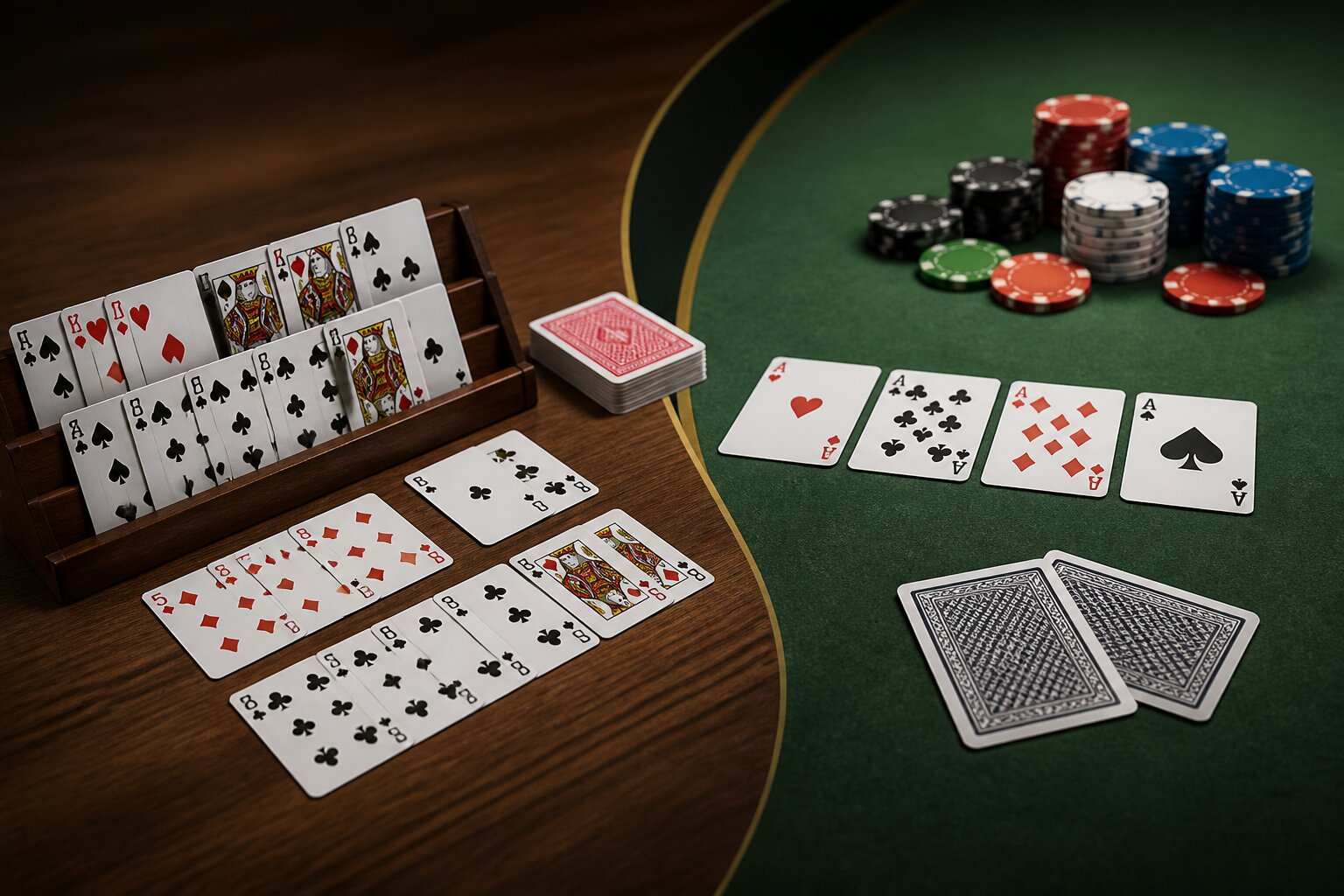
Whether you prefer calm card-sorting or high-stakes bluffing, rummy and poker offer two very different table experiences. Each has its own rhythm, rewards and skills to develop, so understanding the contrasts helps you pick the one that fits you best.
This article walks through how the games are played, how they end, what cards are used and where you can play them online in the UK. Read on to see which game might suit your style and how each one works in practice.
What Are The Main Differences Between Rummy and Poker?
Although both games use familiar playing cards, their aims and day-to-day mechanics diverge.
Rummy is about organising your hand into valid combinations: sets of same-ranked cards in different suits, or runs of consecutive cards in one suit. Play revolves around drawing and discarding as you assemble those combinations. Poker is about making the strongest possible five-card hand from the cards you hold and any community cards, combined with the strategic use of betting to influence who stays in the hand.
The social atmosphere also shifts between the two. Rummy tends to be a conversational, often low-key activity where the focus is on completing combinations and finishing a hand. Poker adds an extra layer of psychological play through betting decisions and observation of opponents. Both demand attention and memory, although poker places more emphasis on betting strategy and reading the table.
A quick transition: now that you know the big-picture differences, it helps to see how the rules shape each game’s flow.
How Are The Rules Of Rummy Different From Poker?
The structure and objectives underlie how each game is played.
In rummy, players are dealt a larger hand—commonly 10 or 13 cards depending on the variant—and the turn cycle centres on picking up one card and discarding one. Valid hands are made of sets and runs, and a player ends a round by completing the required combinations and declaring. Variants adjust the exact card count and scoring, but the core remains forming combinations from what you hold.
Poker typically deals fewer private cards—two in Texas Hold’em being the most common example—and uses community cards to build five-card hands. The rounds proceed with betting, and players choose whether to continue or fold based on their assessments. Poker variants differ in how many cards are shared and how many betting rounds occur, but betting and hand rankings are constant features.
Both games require knowledge of their specific rules before playing. That not only improves enjoyment but also ensures everyone is clear on how a round ends and how winners are determined.
Which Card Decks Are Used In Rummy vs Poker?
Most casual and organised play in both games uses a standard 52-card pack, but how many decks and whether jokers are used varies.
Rummy sometimes uses a single deck for small groups, while larger games can combine two decks and include jokers as wild cards. The use of jokers and the number of decks change the probability of forming sets and runs, and some variants explicitly define how wild cards count in combinations.
Poker is normally played with a single 52-card deck and rarely includes jokers. The consistency of one deck keeps hand rankings and odds stable from game to game, which is important for betting strategies in variants such as Hold’em and Omaha.
Knowing which deck arrangement your group or platform uses helps you adapt tactics and expectations before you sit down to play.
What Is The Objective Of Each Game?
Each game has a clear, contrasting end goal.
In rummy the aim is to arrange your entire hand into valid sets and runs so you can discard your last card and declare. Success depends on efficiently drawing useful cards and minimising the value of any remaining unmatched cards when someone else declares.
In poker the goal is to win the pot, either by holding the best five-card hand at showdown or by making other players fold through betting pressure. The hand-ranking system determines which combinations beat others, so players balance hand strength with the psychological and financial aspects of betting.
Both games reward skillful decision-making, but they channel it differently: rummy through card management and sequence recognition, poker through hand selection, bet sizing and reading opponents.
How Does Gameplay Progress In Rummy and Poker?
Each game develops in stages but follows distinct paths from deal to resolution.
Rummy progresses as a cycle of draws and discards while players gradually build their required combinations. The interaction is mostly about managing your own hand and occasionally observing discards to infer opponents’ needs.
Poker moves through alternating phases of card distribution and betting. Players respond to shared information—the community cards—and to each other’s betting patterns. The interplay between revealed cards and wagering choices creates a layered decision-making process where timing and perception matter.
Hand Rankings and Winning Criteria
Rummy does not use a ranked hand hierarchy. Instead, winning is achieved by completing the specified sets and runs for that variant and declaring first. When scoring is used, unmatched cards usually count against players, which influences decisions on which cards to keep or discard.
Poker relies on a universal ranking of five-card hands—pair, two pair, three of a kind, straight, flush, full house and upwards. The player with the highest-ranking hand at showdown wins the pot, unless everyone else has folded earlier. Knowing these rankings and how community cards can change relative strengths is central to effective play.
The Role Of Betting In Each Game
Betting defines much of poker’s strategy. Stakes are placed in rounds and players choose to check, call, raise or fold, shaping the size of the pot and who remains in contention. Betting serves both a practical function—building the pot—and a tactical one—applying pressure or masking hand strength.
In most casual rummy formats betting does not form part of the core mechanics. The competition is measured by who completes their combinations first, and scoring is resolved at the hand’s end. That said, separate social or club settings sometimes introduce wagers, but they do not alter the internal card-play mechanics of rummy.
Next, we’ll consider how these games translate to online play in the UK and what to expect there.
Can You Play Rummy and Poker Online In The UK?
Both games are accessible online in the UK, but the ways they are offered differ.
Online poker features widely on regulated gaming platforms and follows familiar rulesets like Texas Hold’em and Omaha. These sites provide tools to set deposit limits, self-exclude and monitor play time, which helps players manage their activity. Poker play online mirrors live tournament and cash game structures, including betting rounds and hand rankings.
Rummy is commonly available as a free-to-play or social app experience. Because it is often run as a social game rather than a standard betting product on regulated platforms, cash-based rummy games are less commonly offered by operators that focus on wagering. Always check the terms of any online service so you understand whether real money is involved and which protections apply.
If you plan to play online, choose reputable platforms, confirm any identity and age checks that the site requires, and be aware of tools available to help you control your spending and session length.
Are There Any Common Myths About Rummy and Poker?
A few misunderstandings tend to recur around these card games.
One is that all card games are available for wagering online; in practice, availability depends on the game format and the operator’s licence conditions. Another is that signing up is effortless; regulated platforms require age verification and identity checks to protect players and ensure compliance with legal standards.
Separately, players sometimes assume a single approach or “system” will always deliver success. Both games reward skill and practice, but outcomes vary from hand to hand. Keep expectations realistic and focus on learning the rules and strategies specific to each game.
Which Game Is Right For Me?
The best choice depends on what you enjoy most about card play.
If you favour steady, pattern-based thinking and social interaction without the central element of wagering, rummy is a strong match. It rewards memory and card management and suits casual gatherings where completing hands is the primary challenge.
If you prefer interactive strategy that includes betting, psychological play and the importance of pot control, poker will be more engaging. Poker demands attention to odds, opponent behaviour and bet sizing, and it typically carries higher variance because of the betting element.
Whichever you try first, pick a setting that matches the level of competitiveness and financial exposure you want. Use available account tools and platform settings to set limits that fit your budget and comfort level. Enjoy the learning process, build your skills gradually, and play in ways that suit you.
**The information provided in this blog is intended for educational purposes and should not be construed as betting advice or a guarantee of success. Always gamble responsibly.